struct Student
{
  string name;
  int* hw;
};
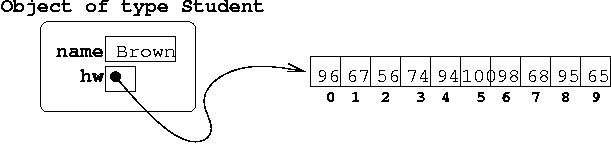
Recall the struct Student we saw from last lecture.
| |
Now, if we're going to sort this array of Student objects, it's
just like sorting anything else! We'll have our array stu
of objects of type student, and we'll use the same old selection sort routine
we've always been using.
|
So, the only thing that remains is to produce a
before function that will take two
Student objects and decide whether the first needs
to come before the second. Remember we want our
Student objects in order from lowest to highest
score on homework #4. So, for before(a,b), I need
to determine whether the homework #4 score for a is
less than the homework #4 score for b.
|
|
Now, at
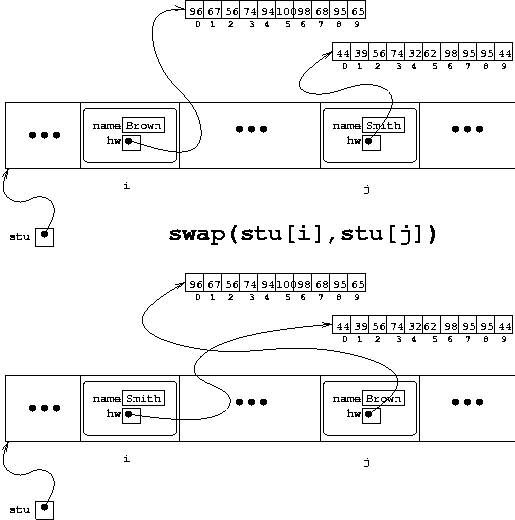
some point in selection sort, we'll swap two elements of
The picture on the left shows how |
x is the assignment number, we'd have to modify
before to be:
bool before(Student a, Student b)
{
  return a.hw[x] < b.hw[x]; // we should sort based on grade x
}
Q. There's a problem in the above code. What is it?
A: Where does the function get x from?
The only way it can get
x is if we pass it in as a parameter. So the
function must look like:
bool before(Student a, Student b, int x)   // int x is added to fix the problem
{
  return a.hw[x] < b.hw[x];
}
before, but it necessitates a change in
selection_sort, which is the function that calls
before.
Q. There's one more problem to fix in selection_sort. What is it?
A: Again, where does the function get x from?
It seems that another parameter is required for selection_sort as
well.
void selection_sort(Student* A, int n, int x) // *** change here
{
  for (int i = 0; i < n - 1; ++i) {
    // find nexti, the index of the next element
    int nexti = i;
    for (int j = i + 1; j < n; ++j) {
      if (before(A[j], A[nexti], x)) {    // *** change here
        nexti = j;
      }
    }
    // swap A[i] and A[nexti]
    Student temp = A[i];
    A[i] = A[nexti];
    A[nexti] = temp;
  }
}
One thing we're going to do is reuse code. This idea is very dear to those of us who are lazy .... A quadrilateral is defined by its four vertices, which are of course points, and we've done quite a lot with points already. As a matter of fact, we used most of these definitions for dealing with points. And we could round this out to include subtraction of points, or I/O, or whatever else we wanted. Instead of reinventing the wheel, let's reuse this code.
Given this, we'll represent a quadrilateral by the four
points that are its vertices, and in the context I
have in mind, we'll also give each quadrilateral a character that
acts as a label. The struct for quadrilateral, which we'll call
Quad, has the following simple definition:
struct Quad
{
  char label;
  point* vert;
};
main() using the struct. All it does is
read in a Quad and print it back out again. Notice
how we create an object of type Quad. It takes two
steps, one actually creates the Quad object, and one
allocates the array of four points that stores the vertices.
int main()
{
  // Create quadrilateral S
  Quad S;
  S.vert = new point[4];

  // Read label and vertices
  cout << "Enter label and 4 vertices: ";
  cin >> S.label;
  for(int j = 0; j < 4; j++)
    S.vert[j] = readpoint(&cin);

  // Write label and vertices
  cout << "Your quadrilateral is " << S.label << " ";
  for(int j = 0; j < 4; j++)
  {
    writepoint(S.vert[j], &cout);
    cout << ' ';
  }
  cout << endl;

  return 0;
}
point stuff, and the new code, which is the
Quad definition and the main function.
Furthermore, the point stuff falls into two obvious
pieces - the struct definitions & function prototypes, and the
function definitions.
point.h -- Prototypes for point stuff |
point.cpp -- Definitions for point-related functions | ||
| main.cpp -- New code with definition for |
Quad and
main
| |
point.h,
main.cpp, and
point.cpp.
point and all of its
related functions, we really only need the function prototypes and struct
definition - the definitions of the functions don't really
concern us as users of point. We only care about
what's available for us to use, not how it works. So, the file
main.cpp begins with the
line:
#include "point.h"point.h was typed in starting at this point.
Thus, as far as the compiler is concerned, it's like that struct
definition and all those prototypes were right there.
point.cpp
also begins with #include "point.h", since those
function definitions won't make sense to the compiler without
the definition of the struct point and the prototypes.
.h file (or header file) that
gives the outside world all the information it needs to use the module,
and a .cpp file that contains the source code that implements the
module (i.e. that tells the compiler how all these functions really work).
What you saw up above was a very simple point module.
One key thing that's missing from my simple point module, however, is documentation. The header file needs a lot of documentation so that the user of the module understands how to use the struct and the various functions the module offers. They don't need to know how it works, but they do need to know what it does!
| Easy way (recommended) | Use this method when you have many cpp files |
You can simply compile the source files as follows:
g++ main.cpp point.cpp -o quadThe above command will create an executable program quad.
|
Your compiler views your program as consisting of two files,
main.cpp and
point.cpp, both of
which use point.h.
|
point struct and a
struct hhmmss. Break the program up into separate
point and hhmmss modules, and of
course a main file. We have the following pieces:
datum, but it seems less likely to be reused, so
there's a less compelling reason for doing it.
A: struct definition of point, function prototypes, documentation of what functions do
A: #include "point.h"
#include <point.h>Fix:
#include "point.h"
A: g++ main.cpp point.cpp (you don't need to include point.h)