A replay attack is a form of network attack in which valid data transmission is
maliciously or fraudulently repeated or delayed.
Replay Attack: Ocean's 11
Security cameras are monitoring a security-sensitive space. Guards in a remote
control room watch video monitors to detect unauthorized access to the door.
One can use the replay attack here to fool the guards:
Record and replay the innocent image to the monitors.
This attack was featured in the film Ocean's 11.
Rubber fingerprint attack
One can see that similar types of replay attack can be used to biometric
authentication as well. A rubber fingerprint attack is a well-known
attack.
| 
|
Replay Attack on the Password-based Authentication
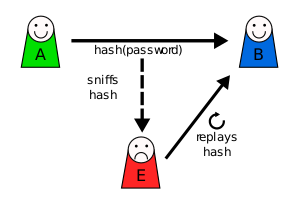
(source: from Wikipedia)
|
Suppose Alice wants to prove her identity to Bob. Bob requests her password as
proof of identity.
- Alice provides (possibly after some transformation like hashing (or even
salting) the password).
- Meanwhile, Eve is eavesdropping on the conversation and keeps the password
(or the hash).
- After the interchange is over, Eve (acting as Alice) connects to Bob; when
asked for proof of identity, Eve sends Alice's password (or hash) read from
the last session which Bob accepts, thus granting Eve access.
|
Encryption cannot fix this!
Note that the replay attack still works even if an encryption scheme is used
instead of a cryptographic hash function (why?)
Other Replay Attacks
See the Wikipedia
page for more details.
Power of Replay Attacks
Please observe the following:
With a replay attack, the attacker need not know the content or format of
a transmission. This means that replay attacks would even succeed on
encrypted data without altering or breaking the encryption.
For example, consider the above scenario of the reprocessed transactions. This
time, suppose a merchant has a credit card terminal with built-in encryption
such that the user's card number, perhaps a PIN, the transaction amount, and
merchant's identifier are encrypted and sent to the credit processing center.
Even without breaking the encryption, a merchant who taps the communications
line can repeat the same transaction message for a second transfer of the same
amount.
When Would a System Be Vulnerable to Replay Attacks?
The vulnerability that the replay attacks exploit is:
The system cannot to detect whether a given data is fresh or stale (i.e.,
copied and reused).
Consider the case of password-based authentication. Alice sends a hash of the
password to Bob. In this case, the credentials are static. Since the same
credentials are repeatedly used even by Alice, Bob cannot detect whether the
sent credential information is from Alice or from an attacker.
Countermeasure
We can address the vulnerability by enabling the system to tell whether a given
data is old or not.
- Clock. For the security camera example, if the security sensitive
place has a clock, then monitoring guards will be able to notice when videos
are replayed, since a replayed video will have old time.
One-time password
Another fix is to use a one-time password.
Hardware token
One-time passwords can be generated easily with a device token. However, there
are disadvantages:
- The user must have the token for each login.
- The token must be synchronized to the access control service.
- The tokens must be distributed and managed securely.
- Tokens cost money.
Hash chains
Let pwd be the password.
In the above, we had the user store the array hashes, which could
be too cumbersome for the user. This can be fixed easily. Instead of storing
the entire array contents, the user can always compute the necessary
credential, using a simple for-loop, if he knows the pwd.
Challenge and response
Let cred be the credential stored in the target system. Then, the
following protocol could also be used to protect against replay attacks:
- The target system chooses a random challenge
r and send it to
the user.
- Then, the user sends the following message
answer:
H(r + cred)
- Since the target system also stores
cred, it can check the
validity of answer by computing the hash on its own.
In the above protocol, the fact that r will be different for each
login implies that the answer would also be different. Therefore,
the replay attack can be avoided.
Sequence Number and Nonce
Sequence number
Recall that the TCP protocol uses sequence numbers to ensure liveness in
a communication session. This idea can be applied to other protocols to avoid
replay attacks.
- The hash chain protocol in the above implicitly uses a kind of sequence
number.
- The challenge-response protocol should also work even if a sequence number
is used.
However, you need to design a protocol carefully so that it has a strategy to
handle missing sequence numbers.
Nonce
A nonce is an arbitrary random number. So, we used a nonce in the
challenge-response protocol in the above.
Some tips:
- In some cases, simple nonces would be enough to protect against replay
attacks.
- However, that may not be the case -- you must carefully check the security
of the overall protocol. For example, the above challenge-response protocol
is slightly changed as follows:
- The random number is chosen by the user instead of the system.
This modified protocol will be broken by the replay attack, unless the system
stores all nonces used so far, which would be impractical if there are many
users.
Use of Cryptographic Tools
Note that we only considered a single kind of attack. However, the attacker
will not be so simplistic --- it will probably use more sophisticated attacks
combining many techniques. So, the system may need to use other cryptographic
tools to provide the security of the system.