- An ADT is a mathematical model of information stored in a computer.
- A Data Structure is a particular arrangement of data in a computer.
- An ADT consists of specification of behavior by providing a list of operations that can be performed on it. It does not say how this gets done in the computer.
- A data structure describes how an ADT gets implemented.
- In java an Interface is like an ADT- says what needs to be done, with no instructions of how.
- When you implement the interface, you write the data structure.
- Which of the following is an ADT/DS:
- Linked List
- Stack
- Array
- Queue
- List

- Node. element of the tree.
- Root. Node at the top.
- Parent. Of 2 nodes, A and B, A is the parent of B is A is directly above B. Nodes can each have only one parent.
- Child. Reverse of parent.
- Sibling. 2 nodes are siblings if they share the same parent.
- Ancestor. Parent, or parent's parent, or... etc.
- External. Of a node, has no children.
- Internal. Of a node, not external.
- Subtree. A portion of a tree that is still a tree.
- element(v) // returns the content of node v
- root() // returns the root node of the tree.
- parent(v) //returns the prent of node v
- children(v) //returns an iterable container holding the children of node v
- isInternal(v) // returns true if node v is internal
- isExternal(v) // returns true if node v is external
- isRoot(v) // returns true if node v is the root
- size() // returns the number of node in the tree
- isEmpty() // returns true if the tree is empty
- positions() // returns an iterable container of all nodes in the tree.
- elements() // returns an iterable container of the content of all node in the tree.
- replace(v,e) // replace the contents of node v with e. return the old contents of v.
- children(v), which takes O(Cv)
- elements(), positions(), which take O(n).
int depth(v)
 d = 0
 while (!isRoot(v))
  v = parent(v)
  d++
 return d
int depth(v)
 if (isRoot(v))
  return 0
 else
  return 1 + depth(parent(v))
int height()
 allnodes = positions()
 max = 0
 for each v in all nodes
  h = depth(v)
  if (h > max)
   max = h
 return max
int height(v)
 if (isExternal(v))
  return 0
 else
  h = 0
  for each w in children(v)
   n = height(w)
   if (n > h) h = n
  return h + 1
- Break the multiplication into repeated addition. instead of
nCv, we have Cv1 + Cv2 +
Cv3 + ... + Cv(n-1) + Cvn
this of course equals n-1, because there are n-1 children in the tree. Thus height is O(n). - Use the average of all the Cv. Since the average of the Cv does not grow with the size of the tree, then it is a constant. Thus nCv is O(n).
- The preorder visits a node, and then performs a pre-order traversal on its children.
- Lets see...
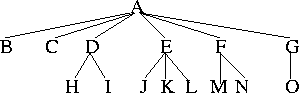
- First we visit A, then we we do a pre-order on the children.
- So we visit B. There are no children, so we go back to A.
- We go down to C, which we visit. again no children.
- We go to D. We visit that, then where? H, then I. etc.
- The Visit Order is: A B C D H I E J K L F M N G O.
preorder(T,v) vist(v) for each w in children(v) preorder(T,w) - Pre order of a book section tree visits nodes in the order read.
- Post order visits a node AFTER doing a post-order of all the children:
- B C H I D J K L E M N F O G A
postorder(T,v) for each w in children(v) postorder(T,w) visit(v) - Post order is useful for things where we want to visit the
parent last (duh). For example, lets say the the tree is a
directory tree, and leaf nodes are all files. We want to print
out the size of the director- the sum of the size of all files in
the directory (or in some descendant directory).
diskspace(T,v) sz = 0; if (isExternal(v)) sz = size(v) for each w in children(v) sz = sz + diskspace(T,w) if (isInternal(v)) print(name(v) + ":" + sz) return sz; - Try it out on the tree. Give some numbers to the leaves and go.