Linked Lists 3: insert after
Insert after a node
One of the nice things about a linked list is that it's pretty
easy to insert new nodes anywhere you'd like. If there's a new value you've
read in, you might not necessarily want to add it to the front of the list or
to the back. You might, for example, want to insert it in a list in a way that
maintains sorted order.
Let's consider a function insert_after(val, P) that will insert a
node containing value val after p so that sorted
order is maintained. Here's what we need to do
in pictures:
We want to add a node with data after p.
We are using the following struct definition:
struct Node {
  double data;
  Node* next;
};
|
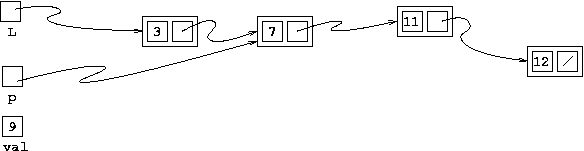
|
Create the new node we want, with the proper data and
next values (drag your mouse to see the code below).
Node *T = new Node;
T->data = val;
T->next = p->next;
|
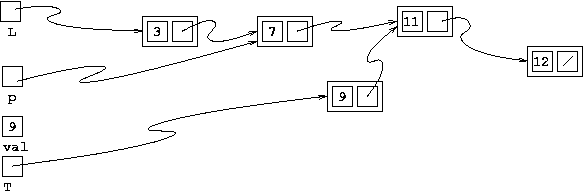
|
Splice our new node in after the node p points to
(drag your mouse to see the code below).
p->next = T;
|
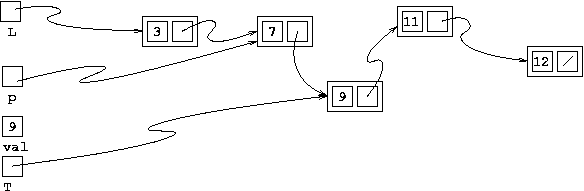
|
| Done! |  |
In summary, we can write the function as follows:
void insert_after(double val, Node* p) {  // When you call this function, make sure p is not NULL
  Node* T = new Node;
  T->data = val;
  T->next = p->next;
  p->next = T                          // if p is NULL, p->next will make your program will crash!!!
}
Adding to the back of a list
Adding to the front of our bare-bones linked lists is very natural. You have
two basic cases, which really need to be handled separately:
- the original list
L is empty
In this case, just use add2front().
- the original list
L is non-empty
In this case, you will have to traverse the list in order to get to the last
node, and then apply insert_after() on this last node.
Here's a nice little implementation of
an add2back function that works in just this way.
#include <iostream>
#include <string>
using namespace std;

struct Node {
  string data;
  Node* next;
};

void add2front(string d, Node*& L);
void insert_after(string d, Node* p);
void add2back(string d, Node*& L);

int main() {
  Node* L = NULL;
  string s;
  while(cin >> s && s != ";")
    add2back(s,L);

  for(Node* p = L; p != NULL; p = p->next)
    cout << p->data << ' ';
  cout << endl;

  return 0;
}
|
void add2front(string d, Node*& L) {
  Node* T = new Node;
  T->data = d;
  T->next = L;
  L = T;
}

void insert_after(string d, Node* p) {
  Node* T = new Node;
  T->data = d;
  T->next = p->next;
  p->next = T;
}

void add2back(string d, Node*& L) {
  if( L == NULL ) {
    add2front(d, L);
  }
  else {
    // find the last node
    Node* last = L;
    while(last->next != NULL)
      last = last->next;

    // insert d after the last node
    insert_after(d, last);
  }
}
|
Insert in order
Suppose we want to maintain a sorted list. Using add2front and
insert_after, we can easily write a function
insertinorder(val,L) that will insert a new value
val into L so that sorted order is maintained.
There are two cases to consider when we write the function:
- Case 1: Place a new node with
val to the front of the list.
- Case 2: Place a new node with
val after some node in the list.
Case 1?
When is case 1 true? We have two sub-cases:
- When the list is empty.
- The value
val is smaller than any value in the list. Note we
are dealing with an already-sorted list, so we can easily check this
condition by comparing answer is when val is smaller than the
value of the first node in the list!
In conclusion, the following code handles case 1:
if( L == NULL || val < L->data )
  add2front(val, L);
Case 2?
In this case, we just need to traverse the list to find the right node and then
apply the function insert_after().
Traverse the list until you find the right node. Let
p point to the currently-visited node.
- You end up traversing the whole list, so
p points to the last node (i.e., p->next is NULL).
In this case we need to insert val after this last node p.
- As in the picture below, when the value
val (i.e., 9)
gets smaller than p->next->data (i.e., 11) for the first
time, you find the right node p.
   for(Node* p = L; p != NULL; p = p->next) {
      if( p->next == NULL || val < p->next->data ) {
        insert_after(data, p);
        break;
      }
   }
Final code
void insertinorder(double val, Node*& L) {
  if( L == NULL || val < L->data ) {
    add2front(val, L);
  }
  else {
    for(Node* p = L; p != NULL; p = p->next) {
      if( p->next == NULL || val < p->next->data ) {
        insert_after(val, p);
        break;
      }
    }
  }
}
Sorting
With our insertinorder we can sort stuff pretty
easily with linked lists. For example, if you want to read in a
bunch of values and put them in sorted order, you can simply put
them in a list as you read them using insertinorder,
and when you're done, you'll have a sorted list of values. Not
bad, eh?
Suppose that you already have a list and it's not in sorted
order. You could easily create a sorted copy of the list by
moving through you list a node at a time and calling
insertinorder for that node's data.
Node* sortedcopy(Node* L) {
  Node* S = NULL;
  for(Node* p = L; p != NULL; p = p->next)
    insertinorder(p->data,S);
  return S;
}
This function returns a copy of the original list in sorted order.
Problems
-
Write a program that reads in commands from the user,
which are quit, add x, and
print.
Each time the add x command is given, the
actual number (as opposed to x) is stored. Each time the
print command is given, all the numbers added thus
far are printed out in sorted order. I'll leave it to you
to guess what the quit command does!
-
Modify the
insertinorder function from above so
that duplicate values are not inserted, but rather simply
ignored. Thus, if used on the example code in which words
are entered, only unique words would appear — no
duplicates.
-
Write a program that reads in a collection of words
(comma-separated, semicolon-terminated) and then prints out
each word (order not important) along with the number of
times that word was entered.
Here's a sample run:
~/$ ./prog
hi , bye , yo , ciao , hi , hallo , yo , sianara ;
sinara 1
hallo 1
ciao 1
yo 2
bye 1
hi 2