n from the
user, reads an n-word sentence from the user, and
then prints out the sentence in reverse (but not the words).
A typical run of the program might look like this:
Number of words: 3
Sentence: I am dumb
dumb am I
Use arrays not recursion! Turn In a printout of your program along with a screen capture showing it running on some clever sentence.
Pointers & Arrays
Last lecture we worked a little bit with accessing characters within an object of typestring by index. This gave us some practice with
indexed collections of objects, but the type string,
remember, is not a basic built-in type in C++. It is
a type that is defined in the string library, as we
will eventually learn to define new types in our programs. So, to
learn about arrays in C++, we will have to return to the basic
built-in types and understand the concepts that are "beneath the
hood" in the string type.
All the basic types in C++ are fixed size objects - a
char is 8 bits, an int is 32 bits,
etc. Arrays don't fit that mold, at least not on the surface.
With arrays, the amount of storage we'll need depends on the
number of objects we want to store in the array - as I said, a
different model. So in C++, you get arrays of 10
ints, for example, by asking for 10 consecutive
int objects in memory and having a variable that
points to the first of these. From this
pointer variable you access a particular one of the 10
ints by index.
A variable is declared as a pointer to a particular
type by putting a * in front of the variable
name. For example, to declare a variable p that is
a pointer to objects of type int, you'd write:
int *p;Now, you'll want to think of
int* as being a new
type, which is really what it is, but the declaration syntax is a
little wierd. For example,
int* p, q;declares
p to be of type int* and
q to be of type int.
So the
int applies to all the variables, but the
* part only applies to the next variable.
If you wanted both p and q to be
"pointers to ints", you'd have to write
int *p, *q;which is unfortunate, but which is syntax C++ inherited from C. In any event, having declared
p as a pointer to objects of
type int, we have to actually allocate some
ints in memory for it to point to! Just declaring
p leaves it uninitialized - i.e. pointing to
nothing, or what's worse, pointing to some random area of memory.
You allocate memory with the new operator, like this:new
type[number]This expression allocates number consecutive objects of type type in memory, and returns a pointer to the first object. Thus, to allocate 10
ints in memory and set
p to point to the first of them, we'd write:
p = new int[10];At this point, we can access any of these
int objects
by the indices 0,1,2,3,4,5,6,7,8,9 just as we did for the
characters within a string. To get the last int
in the array, we write p[9], and since
p[9] is an int, we can do
anything with it we can do with a normal int.
To make this clear, the abstract concept of an array is simply a
collection of n objects, all of the same type, that can
be accessed by index.
In C++, pointer variables and the new operator are
what we use for arrays - the array is really a contiguous block of
objects in memory, and the pointer variable allows us to access
the objects in this block by index.
The following picture depicts what's going on when we create an
array of 4 ints and assign a value to one of the
ints in the array.
| DECLARE VARIABLES | 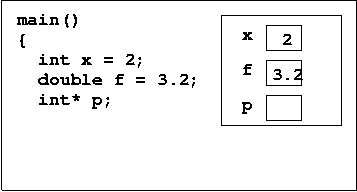
|
| ALLOCATE SPACE | 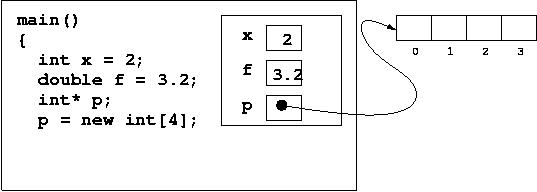
|
| ASSIGN A VALUE | 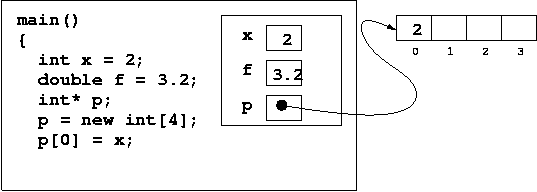
|
A Simple Problem
Let's look at a simple problem that we can solve using arrys: Write a program that reads in a number n from the user, and then reads in ndoubles from the user,
and simply prints them out in reverse order. We already saw from
our excercises with accessing characters within a string
that indexed collections of objects would allow us to print
objects in reverse order.
int main()
{
  // Get number of doubles from user
  int n;
  cout << "How many doubles? ";
  cin >> n;

  // Construct array
  double *A;
  A = new double[n];

  // Read numbers
  cout << "Enter " << n << " doubles: ";
  for(int i = 0; i < n; i++)
    cin >> A[i];

  // Write in reverse order
  cout << "In reverse your numbers are: ";
  for(int j = n - 1; j >= 0; j--)
    cout << A[j] << " ";
  cout << endl;

  return 0;
}
Even an example as simple as this deserves a fair bit of
commentary the first time around. In class we'll go over it in
painful detail, including pictures.
The variable is just a pointer!
Remember, the variable that you're manipulating by name in your program is just a pointer, not the actual collection of object. If you keep this in mind, some things that might otherwise trip you up make perfect sense. For example, what happens when I assign one pointer to anther? Well, they simply point to the same thing! A picture should make this clear.

What's hopefully clear here is that by creating a new pointer
q and setting q = p, we did not
create a new array populated with the same integer
values. We just created a new pointer and set it to point to
the same old array.
Objects allocated with new have no scope!
One of the funky things about objects allocated with
new is that they have no scope. So if, for example,
you wrote a function that called new to allocate some
space, the objects in memory created by new would not
be destroyed when the function returned - even though the pointer
we had goes out of scope. Take this example:
| Before the function call | 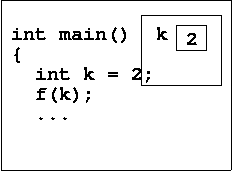
|
| During the function call | 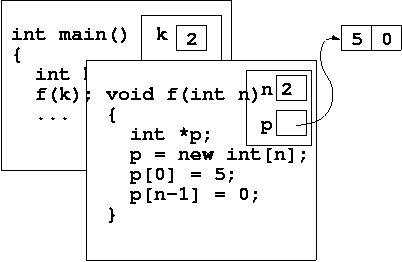
|
| After the function call | 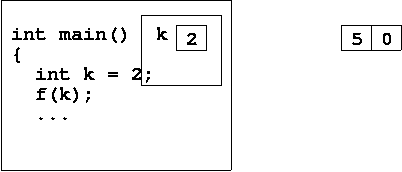
|
You can see that after the function call, our array is still
there - although it's utterly useless, since we no longer have a
pointer with which to access the array. Instead of being
destroyed automatically by scoping rules, objects allocated with
new either stick around until the end of the
program, or are explicitly destroyed with the
delete operator. For example:
char *p;
p = new char[30]; // creates 30 consecutive char's in memory
delete [] p; // destroys the objects created by new
We'll worry more about
delete later.
Problems
-
Write a program to compute dot-products of vectors. If
v = [a1,a2,...,am] and w = [b1,b2,...,bm] are two vectors of
dimension m, the dot product of v and w is
a1*b1 + a2*b2 + ... + am*bm. Your program will get a
dimension m from the user, read in two vectors of length m,
and print out their dot product. Here's a sample run:
Enter dimension: 4
Enter two vectors:
[3,-1,0,2]
[5,0,9,-7]
Dot product = 1
Try it for yourself and then take a look at my solution. - Write a program that reads a list of banned words from a file, stores them in an array, and then simply reads words from the user and returns "banned" or "not banned" until the word "end" is encountered. The file starts with a number, which is the number of banned words, and then the words themselves are listed. The file banned.txt is a good example. Here's my solution.