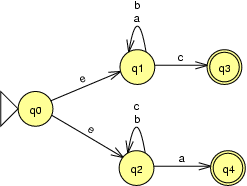
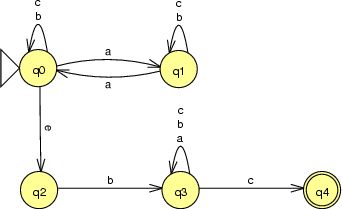
({0,1,2,3}, {a,b,c}, {(0,a,0), (0,b,0), (0,c,0), (0,a,1), (0,e,2), (1,b,0), (1,c,0), (2,a,2), (2,b,2), (2,c,2), (2,b,3), (3,a,2), (3,c,2)}, 0, {2,3})
Design a machine that accepts strings over {a,b,c} of the form: a string containing an even number of a's followed by a string that starts with b and ends with c. Note: This example is not so compelling, a better one would be the language of strings of the form: "a string containing an even number of a's followed by a string whose length is odd".So, for example, the string cabcacbac should be accepted by your machine, becase cabcacbac breaks it up into a piece with an even number of a's followed by a piece that starts with b and ends with c.
One easy way to do this is to construct two machines, one
for "even number of a's" and one for "starts with
b and ends with c", and hook them together
with an e-transistion. Specifically, the
e-transistion takes us from the accepting state of
the first machine to the start state of the second machine.
That way, you'll leave the first machine knowing you've read
a string containing an even number of a's, and
start the second machine knowing you can only end up in an
accepting state if you subsequently read something that
starts with b and ends in c.
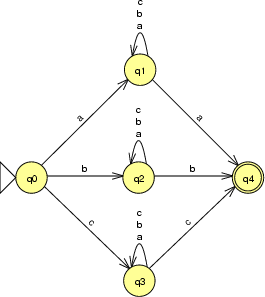
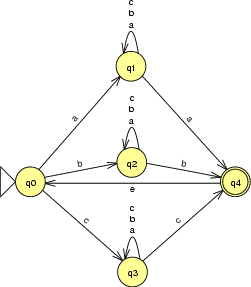
This is, of course, too easy! So let's try to make a machine that accepts strings that look like some number of strings accepted by the above machine, all tacked end to end. In other words, I should accept a string if it can be broken up into pieces, each of which starts and ends with the same letter and has length at least 2
Hopefully you're starting to see that these e-transitions make creating new machines from old ones quite easy. In fact we could have done both of our big examples just using regular old non-dterminism --- i.e. two or more transitions for the same state/character combination. However, the e-transisions let us do things without having to pick apart the original machines and see how they work. That'll help us later when we construct algorithms on nondeterministic machines.
Definition: a nondeterministic finite automaton is an ordered 5-tuple (Q,Σ,Δ,s,W) where
This allows us to look at all the same kind of examples we had for deterministic machines, going back and forth from diagram representation to 5-tuple representation.
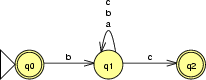
| 5-tuple definition | ({q0,q1,q2}, {a,b,c}, {(q0,b,q1),(q1,a,q1),(q1,b,q1), (q1,c,q1),(q1,c,q2)}, q0, {q0,q2}) |
| diagram definition |
|
What about the rules governing how an NDFA computes? Well, we can borrow the idea of configuration, "yields in one step" and "yields in many steps" straight from DFAs, as long as we add the possibility of e-transitions to "yields". However, they kind of mean different things. Instead of (p,u) ⇒ (q,v) meaning "if you're in configuration (p,u) then after one step you will be in configuration (q,v)", for NDFAs we may only say that (q,v) is one possibility ... there may well be others. So, the big question is how do we define "accept" and "reject" for NDFAs?
NDFA M = (Q,Σ,Δ,s,W) accepts string W if there exists a sequence of configurations C1, C2, ..., Ck such that C1 = (s,w), C2 ∈ Q x W, and C1 ⇒ C2 ⇒ ... ⇒ Ck.