11 students
10 homeworks
Adams	58	96	65	72	93	67	59	74	95	56
Brown	96	67	56	74	94	100	98	68	95	65
 .
 .
 .
telling us initially how many students we have, how many homework scores for each student, and then listing all the student names followed by their homework scores. Now, I'd like to simply read in this data, store it, and then answer user queries concerning the data. For an easy start, we'll just assume that the query will simply be a student name and we're supposed to give the homework average.
Now, assuming there are Ns students and Nh
homeworks, the natural way for us to think of this is to say "I'd like
to have an array of Ns objects of type Student."
We know how to construct a struct Student, so
that't no problem, but what data members would we need to
store this student data? We'd need a string to
store the name, and we'd need ... well, we'd need an array
of Nh ints to store the homework
grades. In other words, we'd need a data member of type
int*.
struct Sudent
{
  string name;
  int *hw;
};
Packaged up this way, an object of type
Student representing the student "Brown" from
above would look like this: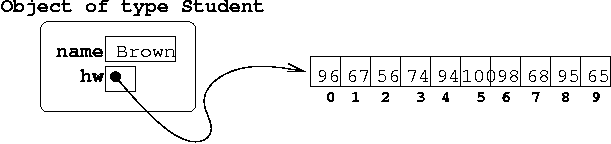
S is
the Student object from the picture, what
expression would give me the value of the homework
assignment with index 2? Well, S.hw is
the name of the pointer to the array of grades, so I just
need to subscript it with a 2: S.hw[2]!
I might be tempted at this point to look back at my original
problem and say that I'll create my storage for all this
student/grade data with:
Student *stu = new Student[Ns];It's true that
stu is now an array containing
Ns object of type Student, but
remember that each Student object has data member
hw, which is just an unititialized pointer at
this juncture. We need to go back and allocate homework-grade
arrays for each Student object in the array. So
creating our storage really looks like this:
Student *stu = new Student[Ns];
for(int j = 0; j < Ns; j++)
  stu[j].hw = new int[Nh];
At this point, writing the program is not very new for us: Here's my solution. All I did was use the top-down design that we've seen so many times. I simply wrote the main function the way I wished I could, and created the structs and functions that made writing main that way possible.
A = B;results in what's called "member-wise assignment". This means that the assignment proceeds by going through each data-member of A and assigning that data member the value of the same data-member in B. So, if A and B are objects of type Student from the above example,
A = B; is the same as A.name = B.name; A.hw = B.hw;You have to think about the consequences of this. After A = B, the pointers A.hw and B.hw have the same value ... that means they both point to the same array! This may not be what you expect. Because of this, for example, the line
A.hw[5] = 100;results in both A and B having 100 for the index 5 value of their hw data member.
The same holds true for pass-by-value with structs: you get member-wise copy. So, when you have structs with data members that are pointers, the pointers get copied but the actual array pointed to stays the same. Think carefully of the consequences of this!
stu of objects of type student, and we'll use
the same old selection sort routine we've always been using. Now,
at some point in selection sort, we'll swap two elements of
stu and I want to take a brief moment to look
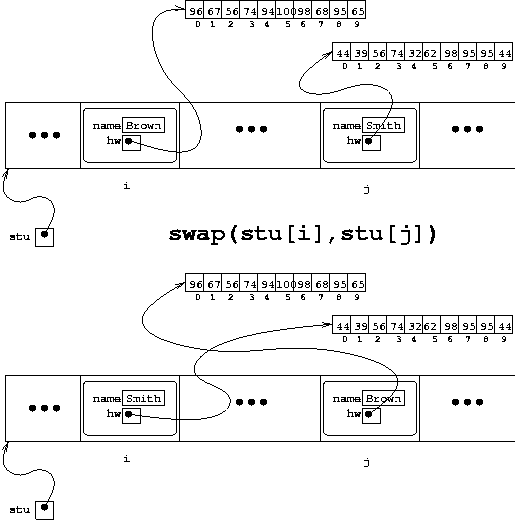
at what that means. The following picture shows how
swap(stu[i],stu[j]) affects things. Hopefully
you see, once again, that we're not moving the actual arrays of
grades at all, we're simply moving the pointers to those
arrays.
Student
objects, it's just like sorting anything else!
void selectionsort(Student *A, int N)
{
  for(int length = N; length > 1; length--)
    swap(A[maxindex(A,length)],A[length-1]);
}
|
int maxindex(Student *A, int N)
{
  int imax = 0, i;
  for(i = 1; i < N; i++)
    if (before(A[imax],A[i]))
      imax = i;
  return imax;
}
|
void swap(Student &a, Student &b)
{
  Student temp = a;
  a = b;
  b = temp;
}
|
before function that will take two
Student objects and decide whether the first needs
to come before the second. Remember we want our
Student objects in order from lowest to highest
score on homework #4. So, for before(a,b), I need
to determine whether the homework #4 score for a is
less than the homework #4 score for b.
bool before(Student a, Student b)
{
  if (a.hw[4] < b.hw[4])
    return true;
  else
    return false;
}
With this, it's easy to write a program that prints out
students & their HW#4 scores ordered from lowest to highest HW#4
score. Here's a complete program.
x is the assignment number, we'd have to modify
before to be:
bool before(Student a, Student b)
{
  if (a.hw[x] < b.hw[x])
    return true;
  else
    return false;
}
However, there's a problem! Where does the before
function get x from? The only way it can get
x is if we pass it in as a parameter. So the
function must look like:
bool before(Student a, Student b, int x)
{
  if (a.hw[x] < b.hw[x])
    return true;
  else
    return false;
}
Now, this fixes before, but it neccesitates a change
in maxindex, which is the function that calls
before.
int maxindex(Student *A, int N)
{
  int imax = 0, i;
  for(i = 1; i < N; i++)
    if (before(A[imax],A[i],x))
      imax = i;
  return imax;
}
Now maxindex has the same question --- where is it
going to get x from? It seems that another
parameter is required for maxindex as well.
int maxindex(Student *A, int N, int x)
{
  int imax = 0, i;
  for(i = 1; i < N; i++)
    if (before(A[imax],A[i],x))
      imax = i;
  return imax;
}
Similarly, sort is going to require an extra
parameter to pass along to maxindex. Putting it all
together, we get this final program.
Pretty nice, eh?
We've dealt with points before, and we will again, so let's go ahead and give the basic struct definition & function prototypes for points:
//--- POINT ---------------------------------//
struct point
{
  double x, y;
};
void read(point &p, istream &IN);
void write(point p, ostream &OUT);
Now, while we may not have dealt with times in hh:mm:ss for a
while, it is not unlikely we'll have to deal with such things
again. Therefore, it is natural to give a struct definition and
some prototypes for an hhmmss struct:
//--- TIME IN HH:MM:SS ----------------------//
struct hhmmss
{
  int h,m,s;
};
void read(hhmmss &T, istream &IN);
bool operator<(hhmmss a, hhmmss b);
Being a little adventurous, I'm living on the edge and defining
the operator< for hhmmss objects.
Might come in useful if I have to figure out what happened first!
Now, a data reading consists of a time and a position, so it might
be nice to have a datum struct that records a single
data reading. It'd look something like this
struct datum
{
  point position;
  hhmmss time;
};
... and I'd probably want a function
void
read(datum
&D, istream
&IN);
to read in such objects. With all of this (and with all these
functions defined!) writing my main function is not too difficult:
  // Read and store data readings
  datum *A = new datum[N];
  for(int i = 0; i < N; i++)
    read(A[i],IN);

  // Get the query time from the user
  hhmmss T;
  cout << "Enter a time: ";
  read(T,cin);

  // Find the first sighting at or after given time
  int k = 0;
  while (k < N && A[k].time < T)
    k++;
Then it would just remain to write out the information to the
user. Take a look at this complete
program. There are several important things to look at
here:
datum struct contains as data members two
other structs I defined --- point and
hhmmss. This is called composition of
data types. We've already been doing this, of course, in
having data members that are of type string.
hhmmss.
This made the code in my main function easier to write.
read!