Name: ____________________________________________________ Alpha: _____________________
Describe help received: _________________________________________________________________
Per-problem assessment:
• 5 (Perfect): Correct solution
• 4 (Good effort): Good effort, solution may or may not be correct.
• 2 (Poor effort): Some basic misunderstandings demonstrated that could have
been cleared up by reading the notes or giving a serious try.
• 0 (No effort): No progress towards a solution.
Install gnome-nibbles on your VM
sudo apt-get install gnome-nibbles
and run it. You don't have to play much, just enough to get the
gist. Notice
that you have this "worm" that lives on a grid. It's body
is made up of a bunch of contiguous cells on that grid.
(NOTE: The worm body cannot cross itself! So a worm
of length n consists of n distinct cells.)
This problem concerns such a worm.
Problem: WormContains
Input: Given arrays X and Y containing the coordinates of the
blocks comprising the body of a worm of length n [assume
the head is at coordinate (X[0],Y[0]) and remember, no
repeated blocks in a worm body!] and a grid coordinate
(x,y)
Solution: true if the worm "contains" (x,y), and false otherwise.
I.e. true if (X[i],Y[i]) = (x,y) for some i in {0,...,n-1}, false otherwise
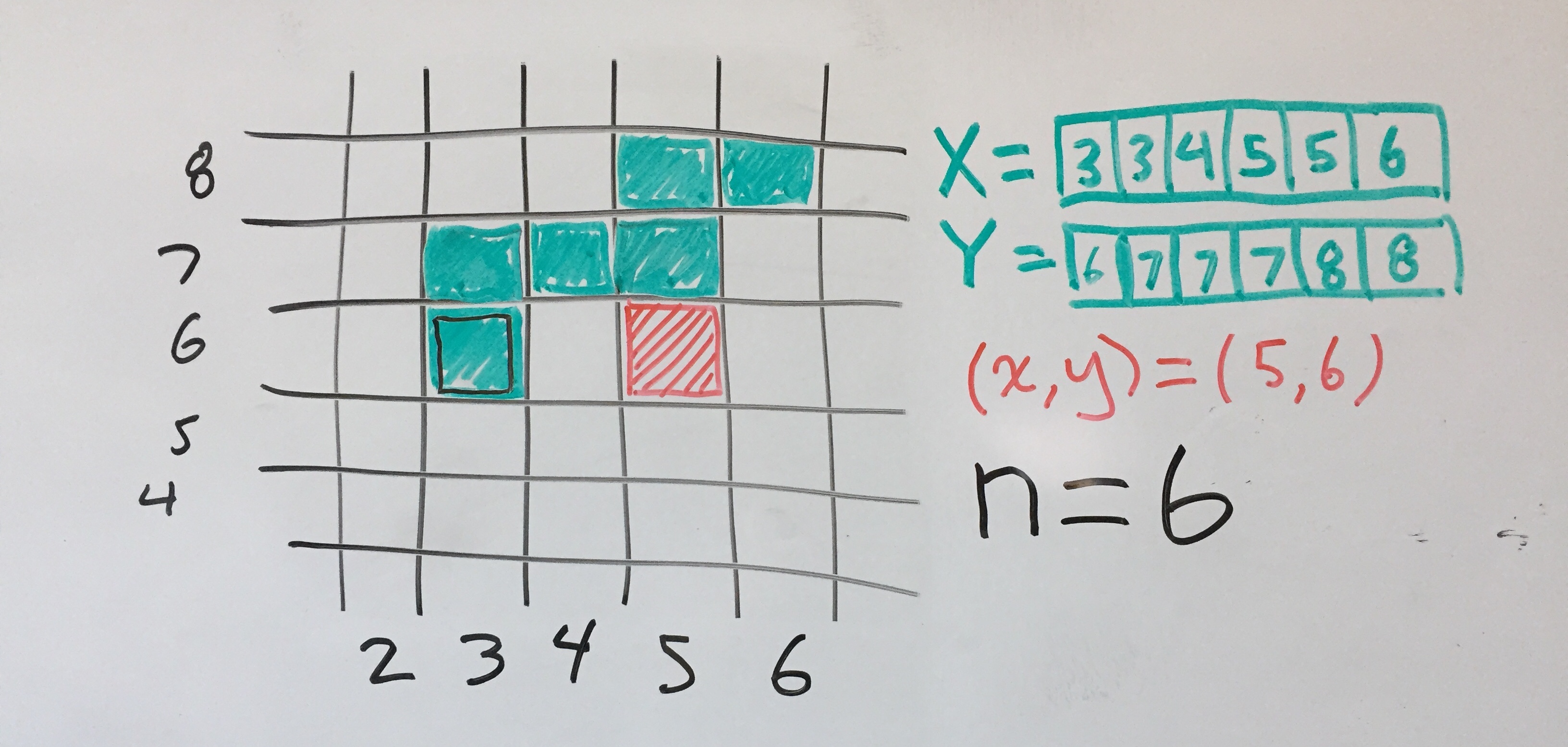
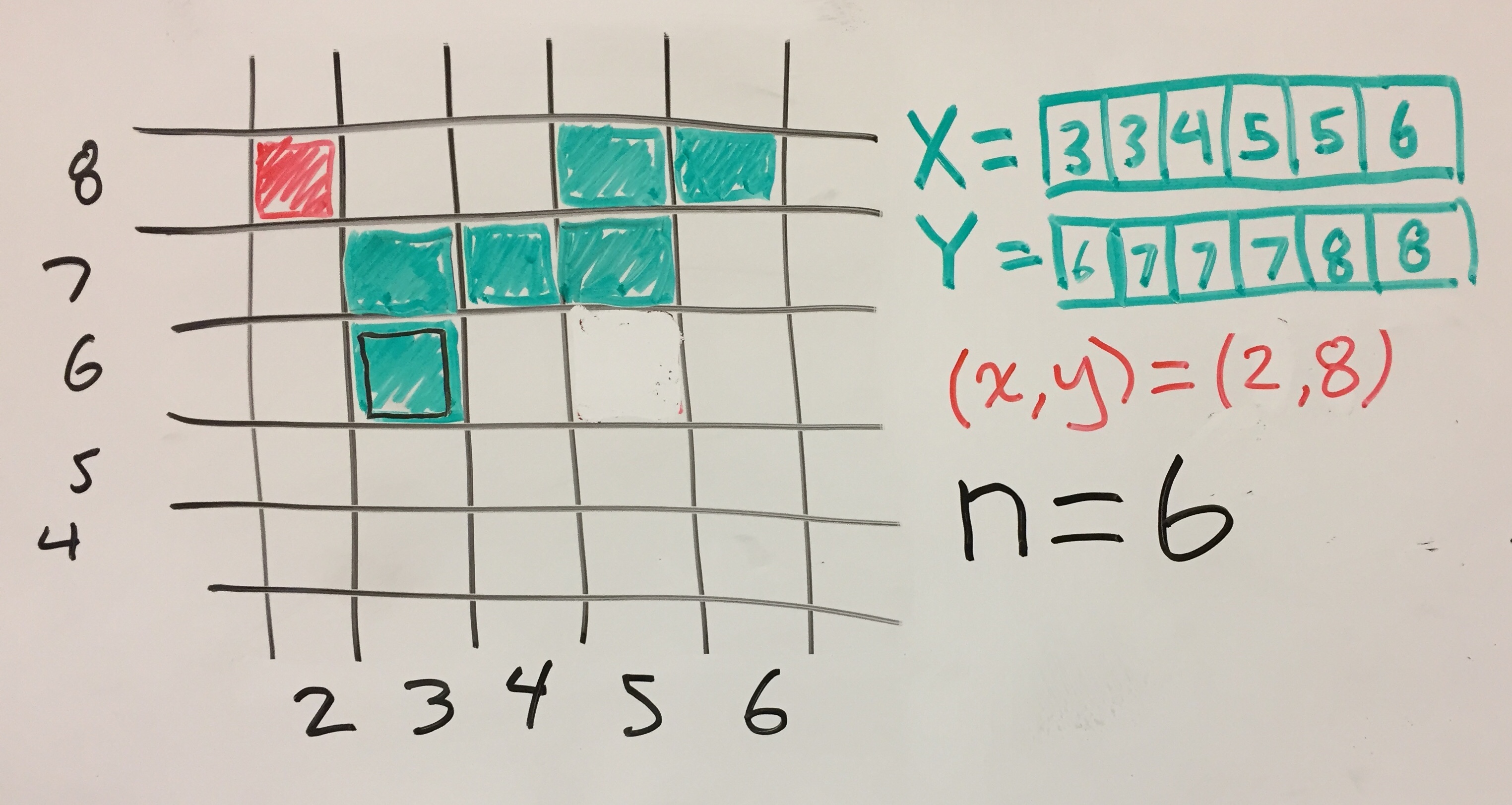
For this input, the solution is "false".
Example:
if n = 5,   X : [ 4 4 3 2 1 ],   x = 2  ----> return true
            Y : [ 5 6 6 6 6 ],   y = 6

if n = 5,   X : [ 4 4 3 2 1 ],   x = 2  ----> return false
            Y : [ 5 6 6 6 6 ],   y = 5
Problem 0 (assessment: self_______ final_______)
Here is a simple recursive algorithm for the Worm Contains Problem.
      Algorithm: onWormEZ(X,Y,n,x,y)
      Input:  arrays X and Y of n integers that represent a worm body, and grid coordinate (x,y)
      Output: true if (X[i],Y[i]) = (x,y) for some i in {0,...,n-1}, false otherwise

      res1 = (X[n-1] == x and Y[n-1] == y)
      if res1 == true or n == 1
        return res1
      else
        return onWormEZ(X,Y,n-1,x,y)
Your Job: Prove that this algorithm is correct.
Problem 1 (assessment: self_______ final_______)
Write a recurrence relation giving an upper bound on the worst
case running time of onWormEZ in terms of $n$.
Problem 2 (assessment: self_______ final_______)
A somewhat cleverer algorithm is based on the observation that
each successive block in a worm body differs from the
previous block only by +/-1 in one coordinate. So if I'm
looking at a worm-body block at
(1,2) and (x,y) = (3,3), I know that the next
two blocks of the worm body cannot possibly be (3,3), so I can
skip over them. If we apply this kind of logic cleverly, we
get the following algorithm:
Algorithm: onWormSPD(X,Y,n,x,y)
Input:  arrays X and Y of n integers that represent a worm body, and grid coordinate (x,y)
Output: true if (X[i],Y[i]) = (x,y) for some i in {0,...,n-1}, false otherwise

i = 0, d = 0
do {
  i = i + d // d = 0 first time through, so this has no effect.
            // Afterwards, this skip over the next d entries of X & Y

  d = |X[i] - x| + |Y[i] - y| // d is the "Manhattan distance" of (x,y) from  (X[i],Y[i]), i.e. the # of
                              // steps to adjacent squares you'd need to take to get from one to the other.
} while (i+d < n and d > 0 )

return d == 0
Your Job: Given the input pictured to the right,
list the values of $d$ and $i$ at the end of every iteration
through the do-while loop.
Problem 3 (assessment: self_______ final_______)
Algorithm: findFirstMissing
Input: $A$ and $B$, both sorted arrays of $n$ ints
Output: $j$, the least index such that $B[j]$ is not an
element of $A$, or 'NOT FOUND' if no such element of $B$ exists
j = -1, k = -1
while k ≠ NOTFOUND and j < n-1 do
  j = j + 1
  k = search(A,0,n-1,B[j]) ← we assume "search" is an algorithm for the search problem, we
if k = NOTFOUND              could equally well use linearSearch, binarySearch or gallopSearch.
  return j
else
  return NOTFOUND
I recommend tracing through this algorithm on example
input. For instance, with n=8 and A and B given below you
should return 5.
Your Job: give a loop invariant for the while
loop that would allow you to prove that this algorithm is correct.
(No proof needed, just the condition.)