Reading
These notes and
closely review
Unit 5
Section 3 intro and 3.1.
Review
We reviewed the original DFSVisit algorithm and the loop
invariant $I_2$ from last class, and we went through the proof
(in last class's notes) that, when DFSVisit(G,s) completes, all
vertices reachable from s are marked "processed".
Augmented DFSVisit from homework
In your programming classes you have, hopefully, learned the
lesson that it is often good when writing a program to solve a
problem, to start with a simple program that solves an easier
version of the problem, get that to work, and then augment
(i.e. add onto) the program to get closer to solving the
original problem. The same thing is true for algorithms.
Now that we have DFSVisit, we understand it well, and we know
that it is correct ... let's augment it to do even more.
DFSVisit(Graph G, vertex s) ← assume G is an adjacency list rep
initialize S to an empty stack of vertex-integer pairs [ count=0; set starttime and endtime for all vertices to +∞]
mark s active [ set starttime of s to count; count++ ]
S.push((s,0))
while S not empty do
  (u,i) = S.pop()
  if i is less than the number of neighbors of u
    S.push((u,i+1))
    v = G[u][i]
    if v is unvisited
      mark v active [ set starttime of v to count; count++ ]
      S.push((v,0))
  else
    mark u processed [ set endtime of u to count; count++ ]
Here are a few obvious observations about the augmented
algorithm and the new starttime/endtime values it tracks:
- if $x$ has starttime and endtime equal to +∞ then $x$ is unvisited
- if $x$ has starttime < +∞ and endtime = +∞
then $x$ is active
- if $x$ has starttime and endtime < +∞ then $x$ is processed
A Deeper loop invariant
One more loop invariant for you!
-
$I_4$:
if there is a path starting from vertex $x$ where
starttime $x$ is less than the starttimes of all the other
vertices on the path, then the endtime of $x$ is greater
than or equal to the endtimes of all the other vertices on
the path
This loop invariant (we prove that it is indeed a loop
invariant below) is important, because it tells us that if
there is a cycle in the graph that is reachable from the start
vertex, we will come to a situation where child $v$ of $u$ is
marked "active", and that means it completes a cycle!
$I_4$ is loop invariant for the while loop in the augmented
DFSVisit algorithm.
Initialization: When only $(s,0)$ is on the stack, $s$ and all
other vertices have endtime +∞, so $I_4$ holds trivially.
Maintainance:
Assume $I_4$ holds at the beginning of a loop iteration. And
consider arbitrary vertex $x$ and path
$x\rightarrow y_1 \rightarrow y_2 \rightarrow \cdots
\rightarrow y_k$, where all the $y_i$'s have starttime greater
than starttime of $x$.
[Note: nothing the algorithm does can change which paths
satisfy this requirement.]
What we need to show is that the endtime of $x$ is greater
than or equal to the endtimes of all the $y_i$'s at the end of
the loop iteration.
We consider three cases:
-
Case $x$ is visited:
This cannot happen, since otherwise
starttime of $x$ is +∞, which is not less than any other
starttime.
-
Case $x$ is processed:
In this case starttime and endtime of $x$ are
fixed (i.e. never change), and endtime of $x$, which we
will call $t$, is less than +∞.
Since $I_4$ holds, $y_1,y_2,\ldots,y_k$ have
endttimes less than $t$. Their endtimes can never be
lowered, so they will continue to have endtimes less than $t$.
-
Case $x$ is active:
In this case $x$ is on the stack, and therefore endtime of
$x$ is +∞.
-
Subcase - the mark of $x$ is not changed to
processed in this iteration:
Then endtime of $x$ will remain
+∞, which is (of course!) greater than or equal to the
endtimes of $y_1,y_2,\ldots,y_k$.
-
Subcase - the mark of $x$ is changed to processed in this iteration:
Then $x$ must be
at the top of the stack at the beginning of this
iteration, which means
that all other active vertices have starttime less than that of
$x$. So any $y_i$ with starttime less than +∞ must be
processed.
Assume there is a vertex
on the path with starttime equal to +∞.
Then let $y_i$ be the first such vertex.
If $i=1$, $y_i$ is a child of $x$, which means it
can't be unvisited since we are changing the mark of
$x$ to processed this iteration.
Otherwise, vertex $y_{i-1}$ exists and has starttime less than +∞, which means
it is processed, which means that it all of its
children (including $y_i$) are
either active or processed, which
means they have starttime
less than +∞. This contradicts our assumption.
Therefore all of the $y_i$'s have starttime less than
+∞ but greater than starttime of $x$, which
means they must be processed. This in turn means that
their endtimes are less than the current value
of count, which is the value the
endtime of $x$ gets in this loop iteration.
Close the loop
We can finally prove the observation made earlier: that DFSVisit
will come across an edge from $u$ to $v$ where $v$ is active
(i.e. on the stack) if and only if there is a cycle in the graph
that i reachable from the start vertex.
Graph $G$ has a cycle reachable from vertex $s$ if an only if
at some point during DFSVisit(G,s) vertex $v$ is already
marked active prior to the if statement.
First we prove that if $v$ is already active, then there is a
cycle. This is clear because $v$ being active means it is
already on the stack, so the stack vertices in order from $v$
to $u$ form a path, and then the edge $u\rightarrow v$ closes
the cycle.
Second we prove that if there is a cycle, we will eventually
find a $v$ that is maked active. Suppose
$C$
is a cycle in $G$ that is reachable from $s$.
Let $x$ be the first vertex from cycle $C$ to be pushed on
the stack. Let $y$ be the prececessor of $x$ in the cycle.
There is a path (the cycle) from $x$ to $y$, and $x$ has the
only starttime less than +∞ of all those vertices.
Moreover, all those vertices are guaranteed to get starttimes
greater than starttime of $x$, which means that, as the algorithm
progresses, $I_4$ guarantees that endttime of $x$ is greater
than or equal to the endtimes of all the other vertices in the
cycle - including $y$. Let $i$ be the index such that $x$ is
the index $i$ child of $y$. Eventually $(y,i)$ will get
popped off the stack, and "vertex $v$" in the algorithm will
be $x$. Since $y$'s enddtime will still be +∞ at this
point, $x$'s enddtime will be as well, which means $x$ is
still on the stack.
What if we want it all?
If we are given a graph $G$ and we want to know if $G$ has any
cycles, just calling DFSVisit may be insufficient, because we
only discover cycles that are reachable from whatever our start
vertex was. So what do we do? We simply call DFSVisit over and
over, always starting at a so-far-unvisited node. Like this:
for i from 0 to n-1 do
  if vertex i is unvisited
    DFSVisit(G,i)
We'd like to think that there is a cycle in $G$ if and only if
at least one of the DFSVisit calls encounters "vertex $v$" that
is marked "active" (i.e. on the stack). However, our proofs of
correctness for DFSVisit and for the cycle property all assume
DFSVisit starts with all vertices unvisited, which is not true
in the above, which uses DFSVisit multiple times. We'd like to
be confident that these results are still true without having to
re-prove everything. Here's a little trick. Consider creating
a new graph $G'$ by adding to
$G$ a new dummy vertex "-1" that has no incoming edges and has
outgoing edges to every vertex in $G$. The above algorithm is
exactly equivalent to running DFSVisit once on graph $G'$ and
start vertex -1. Thus we get that all vertices of $G$ are
visited (since all are reachable from -1), and there is a cycle
in $G$ if and only if vertex $v$ in DFSVisit is never "active"
at the point where we check whether it is "unvisited" (since the
-1 vertex cannot be part of a cycle).
Loops and directed acyclic graphs (DAGs)
Review homework, where DFSVisit finds a cycle.
Remember: there is a cycle in a directed graph G if and only if
DFSVisit finds a vertex v in the inner loop that is marked "active".
Note: we really need to call DFSVisit repeatedly (though
always on an undiscovered vertex (i.e. "unvisited"), so that
we look at all parts of the graph. This is the "DFS" from the
previous notes.
Specifically, we will end up
looking at every edge exactly once.
This means we can determine whether there is a cycle (and
find one if it exists) in time $O(n + e)$, where $n$ is the
number of vertices and $e$ is the number of edges.
A Directed Acyclic Graph is called a "DAG", and these graphs
have lots of important applications in computer science.
I mentioned two important ones
- Makefiles
-
Compiler optimization.
I covered an example in class related to
DAG-Based
Optimization
of IR Code in a Basic Block by Harry H. Porter
Topological sort, and reviewing the homework
Reviewed homework some more. What we discovered is this:
Theorem: Given graph $G$, if a full depth-first search
(based on DFSVisit)
of $G$ is performed, and the vertices of $G$ are ordered in
the reverse of the order in which they are marked "processed"
during the search (i.e. $u$ comes before $v$ only if $u$ was
marked "processed" later than $v$), then all edges in the graph are
oriented from vertices earlier in the order to vertices later
in the order.
An ordering like this is called a "topological sort" of the
graph. Of course, this is only possible for DAGs. We talked
about the importance of topological sort in producing
schedules for tasks with ordering constraints defined by a
DAG.
An example of where DAGs are important
Suppose we have a boolean function represented by the
propositional logic formula:
(x1∨¬x2)∧(¬x3∨¬(x1∨¬x2))∧(x2∨¬x3)
 Hopefully you all recognize that this is represented by the
expression tree on the right. If you view this tree as a
directed graph with the edges going up from the leaves to the
root, you can see this graph as telling us how to evaluate the
formula. To evaluate the leftmost ∨-node, we need the values
x1 and ¬x2 that feed into it. So they must be
fetched/computed first.
Hopefully you all recognize that this is represented by the
expression tree on the right. If you view this tree as a
directed graph with the edges going up from the leaves to the
root, you can see this graph as telling us how to evaluate the
formula. To evaluate the leftmost ∨-node, we need the values
x1 and ¬x2 that feed into it. So they must be
fetched/computed first.
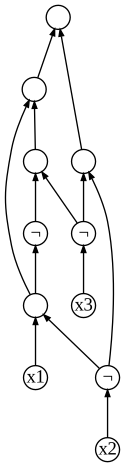 Computing the value of the formula based on this tree is
inefficient. If you look, you'll see that you are
computing/fetching the same thing multiple times. If we
imagine wanting to generate assembly code to evaluate this
formula, you would rather compute something once, store it in
a register, then use it over and over. To represent that kind
of evaluation, we simply allow multiple edges out of a vertex
to represent using the same value multiple times. With this
in hand we arrive at something like the graph shown on the
left. This is no longer a tree. Instead it is ... a DAG!
It is more efficient to base our evaluation off this DAG,
because we avoid duplicate complications. We can label each
node with a register number. To compute the value at a
vertex, use the
register numbers of their predecessors to get input values, and store
results in the register label of the vertex. The problem now
is this: what order to I compute things in. Well ... do a
topological sort! That will give you an order that ensures
that the inputs to the operation at a given vertex have been computed and
stored in their associated registers before we try to actually
perform the operation. In class I also talked about how we
could reorder intructions once we had the topological sort to
produce more efficient code.
Computing the value of the formula based on this tree is
inefficient. If you look, you'll see that you are
computing/fetching the same thing multiple times. If we
imagine wanting to generate assembly code to evaluate this
formula, you would rather compute something once, store it in
a register, then use it over and over. To represent that kind
of evaluation, we simply allow multiple edges out of a vertex
to represent using the same value multiple times. With this
in hand we arrive at something like the graph shown on the
left. This is no longer a tree. Instead it is ... a DAG!
It is more efficient to base our evaluation off this DAG,
because we avoid duplicate complications. We can label each
node with a register number. To compute the value at a
vertex, use the
register numbers of their predecessors to get input values, and store
results in the register label of the vertex. The problem now
is this: what order to I compute things in. Well ... do a
topological sort! That will give you an order that ensures
that the inputs to the operation at a given vertex have been computed and
stored in their associated registers before we try to actually
perform the operation. In class I also talked about how we
could reorder intructions once we had the topological sort to
produce more efficient code.