
The Continental Navy's First Frigates
POSTED ON: Friday, December 12, 2025 12:00 AM by Jennifer Bryan
The 126th Army-Navy Game will take place on December 13, the day on which, 250 years ago, the Second Continental Congress approved the construction of 13 frigates for the fledgling Continental Navy. That navy was born on October 13, 1775, when Congress resolved to arm two vessels "for intercepting such transports as may be laden with warlike stores and other supplies for our enemies, and for such other purposes as the Congress shall direct." On October 30, Congress appointed a committee -- the Naval Committee -- to oversee fitting out the two vessels of the October 13 resolution and authorized two additional armed vessels "for the protection and defence [sic] of the united Colonies." By the beginning of December, the Naval Committee had acquired and converted four vessels and named them Alfred, Columbus, Cabot, and Andrew Doria. On December 11, Congress appointed a committee with one member from each colony to "devise ways and means for furnishing these colonies with a naval armament." Five of the seven members of the Naval Committee served on this new committee, which would be known as the Marine Committee, and it was this committee's report that Congress adopted on December 13.
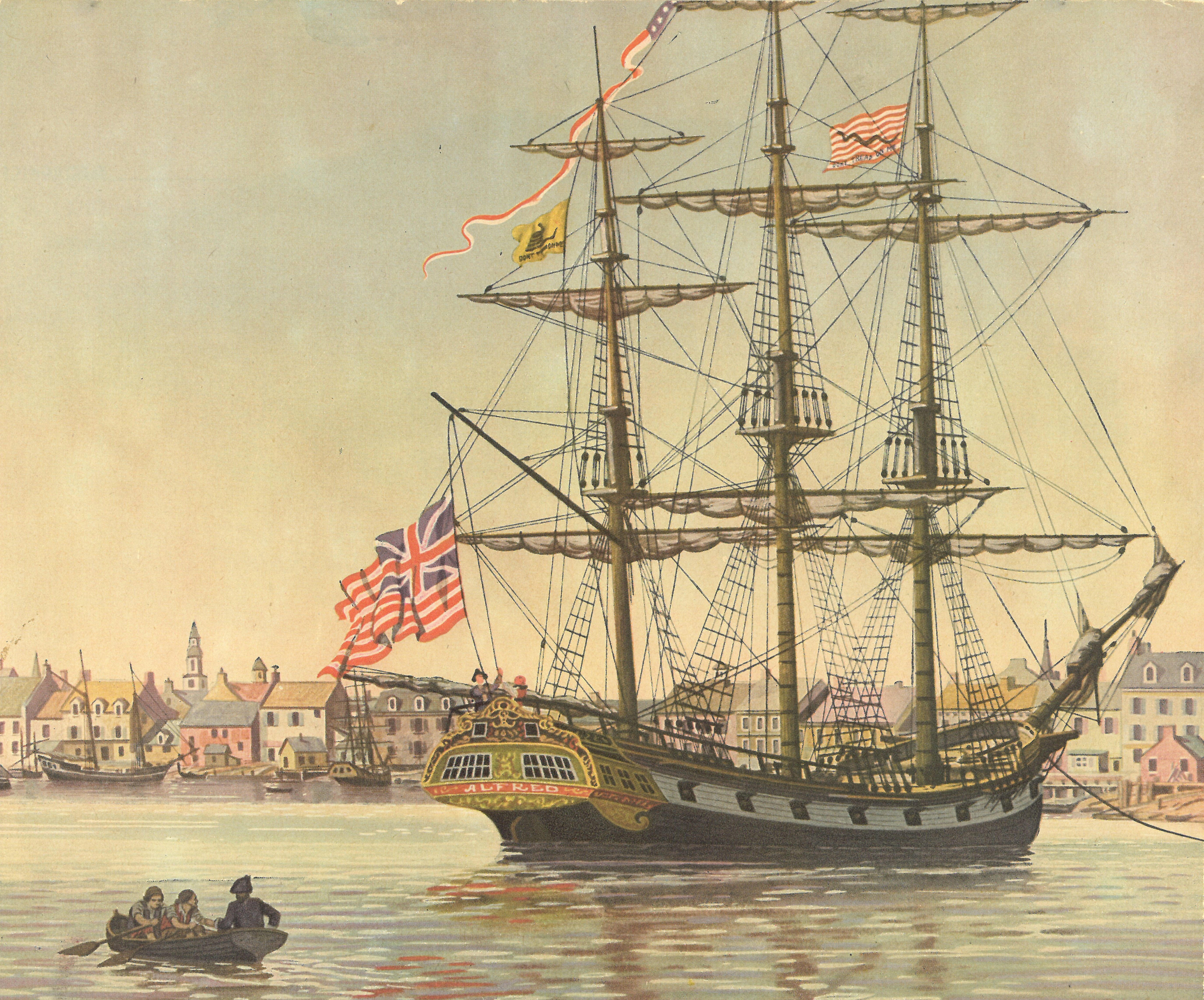
The Continental Navy ship Alfred from the Special Collections and Archives Department's picture file. This illustration was used in advertising for the Continental Distilling Corporation of Philadelphia and appeared in Life magazine on January 22, 1945.
With the decision to build 13 frigates, Congress fully embarked on what Maryland delegate Samuel Chase had called "the maddest idea in the world" -- the creation of an American fleet. Five of the 13 frigates were to be of 32 guns, five of 28 guns, and three of 24 guns. The ships were to be built in several colonies: one each in New Hampshire, Connecticut, and Maryland; two each in Massachusetts, Rhode Island, and New York; and four in Pennsylvania. The committee had been overly optimistic in thinking these warships would be ready for sea by the end of March. Only three had been launched by June 6, 1776, when Congress gave names to the ships: Congress, Randolph, Hancock, Washington, Trumbull, Raleigh, Effingham, Montgomery, Warren, Boston, Virginia, Providence, and Delaware.
None of the newly built frigates of the Continental Navy survived the American Revolution. Between 1777 and 1781, Providence, Raleigh, Boston, Hancock, Delaware, Virginia, and Trumbull were captured; Warren, Washington, Effingham, Congress, and Montgomery were blown up, scuttled, or burned to prevent capture; and the Randolph was blown up in action against HMS Yarmouth on March 8, 1778. The Navy was reborn in 1794 with passage of an Act to Provide a Naval Armament, which authorized construction of six frigates: United States, Constellation, Constitution, Congress, Chesapeake, and President. It is these six frigates, in particular USS Constitution, the oldest commissioned warship still afloat, that the Naval Academy football team uniforms honor for the Navy's 250th anniversary. GO NAVY! BEAT ARMY!

Illustration of the USS Constitution from the U.S. Naval Academy Christmas Card, 1931.
Sources:
Brewington, M.V. "The Designs of Our First Frigates." The American Neptune 8 (January 1948): 11-25.
Clark, William Bell. "American Naval Policy 1775-1776." The American Neptune 1 (January 1941): 26-41.
Clark, William Bell, William James Morgan, and Michael J. Crawford, eds. Naval Documents of the American Revolution. 13 vols. Washington: Naval History Division, Department of the Navy, 1964-2013.
Ford, Worthington Chauncey et al., eds. Journals of the Continental Congress 1774-1789. 34 vols. Washington: Government Printing Office, 1904-1937. All quotes are from volume 3.
Category: Naval & Military Studies, History, Special Collections & Archives