
Counterfeit Bills: Pretenders to the Navy Mascot's Throne
POSTED ON: Friday, December 13, 2019 12:00 AM by Adam Minakowski
A recent post looked at the Navy's mascot, Bill the Goat, during the 1930-50s and how the numbering of these goats got off track during these decades. A 1934 article in the Baltimore Sun was the first in Special Collections & Archives' reference files that assigned regnal numbers to the mascots, but subsequent articles in local newspapers adopted a different set of numbers. A 1950s era article from the midshipman publication, The Log, set the record straight by following the 1934 article's numbering, but due to the untimely deaths of a few mascots and their emergency replacements, even this article is inaccurate, and the house of Bill contains a few pretenders to the throne.
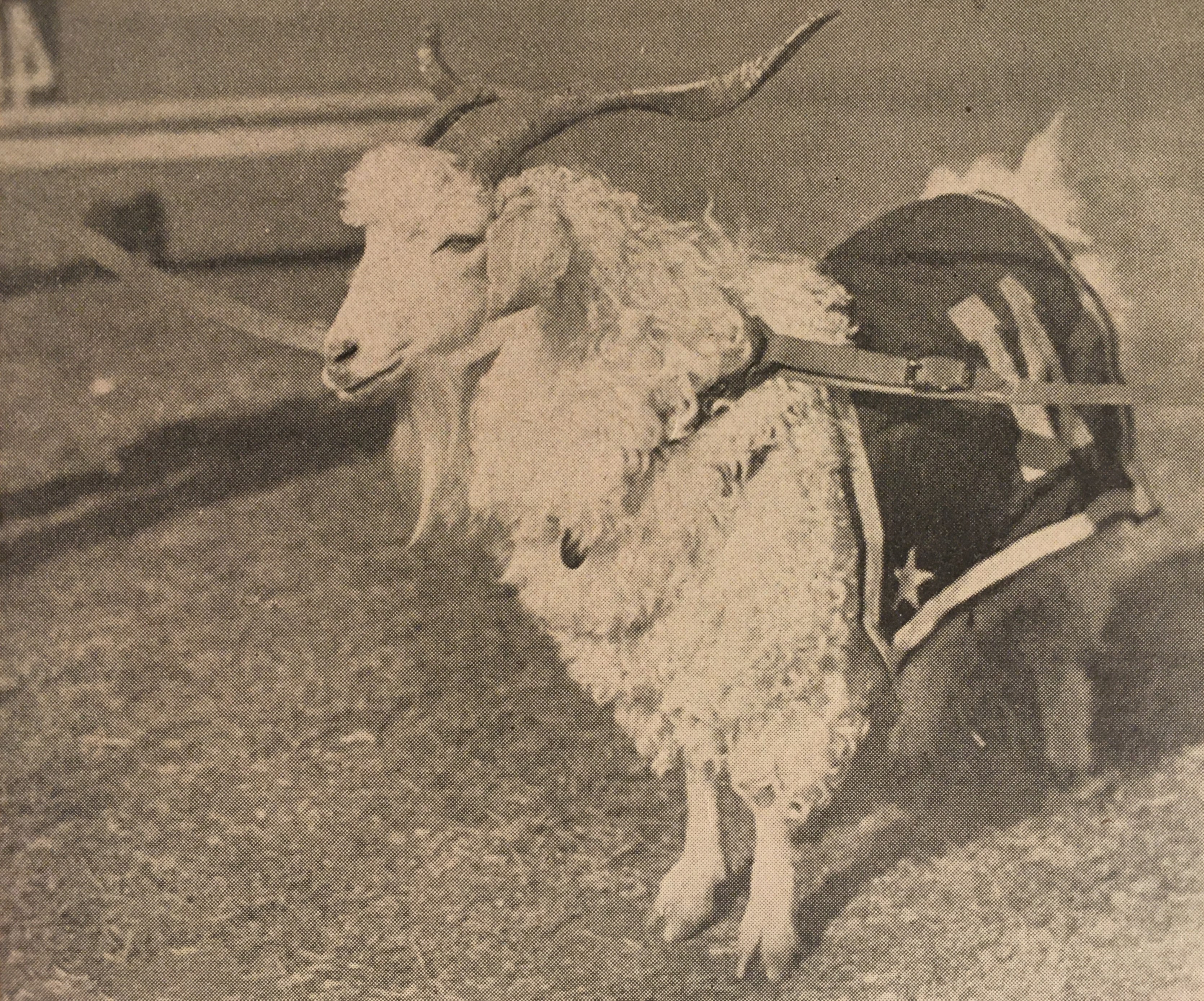 |
| Bill X from the the Nov. 23, 1945 issue of The Log. |
The first pretender was a goat presented to the academy by Ecuador's president, Carlos Arroyo del Rio in 1943. According to a Baltimore Sun article, President del Rio learned that his ambassador to the US, a West Point graduate, had given the cadets a mule as a mascot, and "in order that no partiality be shown he would send the midshipmen a goat." However, there's no other reference to this goat. According to The Log article, the mascot at the time, Bill XII, reigned from 1937-1945. Newspapers referred to this goat as "Bill VIII," and the Annapolis Capital records him dying in 1941, with his successor serving from 1941-1945. Either way, the 1943 goat from Ecuador remains unaccounted for.
Regardless of his regnal number, Navy's reigning mascot died just prior to the 1945 football season, initiating the goat version of England's War of Roses with multiple goats competing for the crown. Needing a replacement quick, the academy accepted a goat from a local farmer. Dubbed "Razor Bill" by a Baltimore Sun article which described him as "a real rollicking Popeye of a goat - with double twisted horns and a mean disposition," Bill X - so called by another newspaper - was, "unlike his predecessors, ... a commoner of uncertain ancestry." The article noted that "already an intrigue is underway to put a pedigreed Texas angora on the throne." This angora - named Chester after Fleet Admiral Nimitz - was delivered by air to academy by Texas Governor Coke Stevenson and was promptly christened "Bill X" while Razor Bill faded into the shadows.
While the midshipmen fared well in the 1945 season under Bill X, they found themselves in 1946 with a 1-7 record entering the Army-Navy game and speculating that a new mascot might change their fortunes. Governor Stevenson obliged with a new goat, Geronimo, that promised to be a "pugnacious big smelly animal," but when "compared to Billy X, he looked small [and] was tamer," according to the Annapolis Capital. Bill X retained his crown, and Geronimo went to live at the Naval Academy Dairy Farm, where the mascots were kept at the time, and died over the winter of 1946.
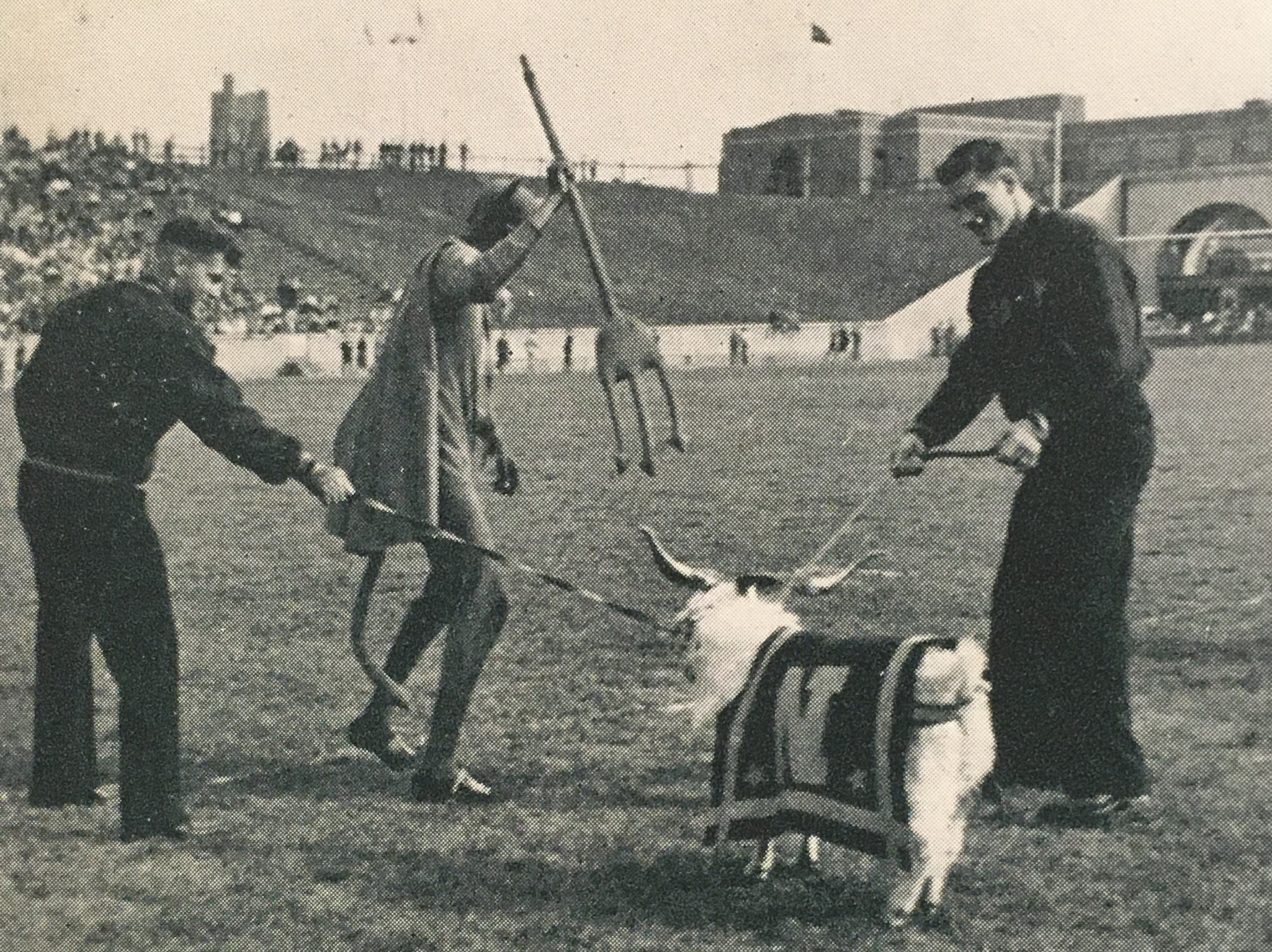 |
| Bill X faces off against Duke's blue devil from the 1948-B Lucky Bag. |
Bill X lasted one more year, and when he died, even academy officials were having trouble keeping track of who was who. The memo to the athletic director, Captain E. B. Taylor, could only refer to "Bill X or XI, the goat that died last night." The night in question was November 20, 1947, which meant there was only a little more than a week to find a replacement for the Army-Navy Game. Fortunately, "a new large blue Norwegian goat" was donated the next day by Roger Williams, an Annapolis barber and World War I veteran, and was immediately designated Bill XI. However, Texas officials did not want to see their dynasty end and promptly sent another angora to Annapolis resulting in two goats traveling to Philadelphia. Who would actually take the field was a game time decision.
The Log timeline records the blue Norwegian goat reigning from 1947-1959, but newspaper articles from the late 1940s and 1950s identify the mascot as a Texas angora (referred to as either Bill XI or Bill XII or Bill XIV when the regnal numbers finally achieved consistency). It appears though that rather than watch rival dynasties battle over the crown as the English had to do during the War of the Roses, the Naval Academy was content to allow multiple goats to preside as mascots as it does today.
Sources
"President Arroyo del Rio Gives Goat to Midshipmen," Baltimore Sun, Nov. 27, 1943.
"New gridiron mascot installed at academy," Aug. 22, 1945.
Taylor, Craig E. "Chester, Texas Angora Goat Replaces Razor Bill at Navy," Baltimore Sun, Sept. 16, 1945.
"Gentle Bill X Gives Way to Fighting Bill XI," Annapolis Evening Capital, Nov. 20, 1946.
"Navy to Get Second Goat," Baltimore Sun, Nov. 25, 1947.
E.W. Hessel to E.B. Taylor, 21 November 1947, "Mascot Goat," Naval Academy Reference Files, Special Collections & Archives Department, Nimitz Library, United States Naval Academy.
Category: History