
The Japanese Bell and its many travels
POSTED ON: Thursday, November 5, 2020 12:00 AM by Special Collections & Archives
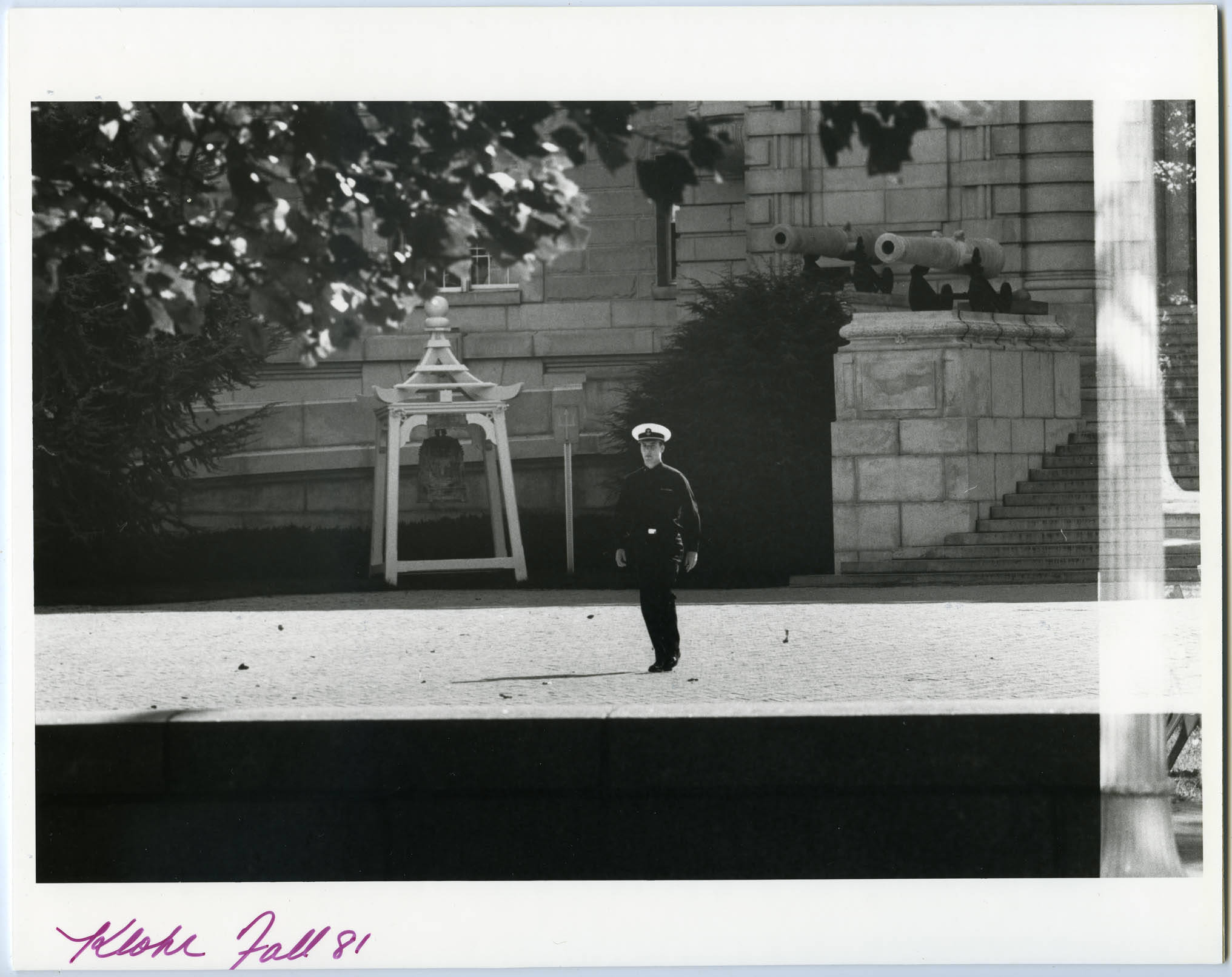 |
| The Japanese Bell in front of Bancroft Hall, 1981 |
The Japanese Bell seen above has a long and storied history. The bell was cast in 1456 from ore mined at Haneji Village, in northern Okinawa, for the Dai-Anzen-Ji Temple built by Sai Zan, a minister from China. Translation of the Japanese inscription on the bell reads,
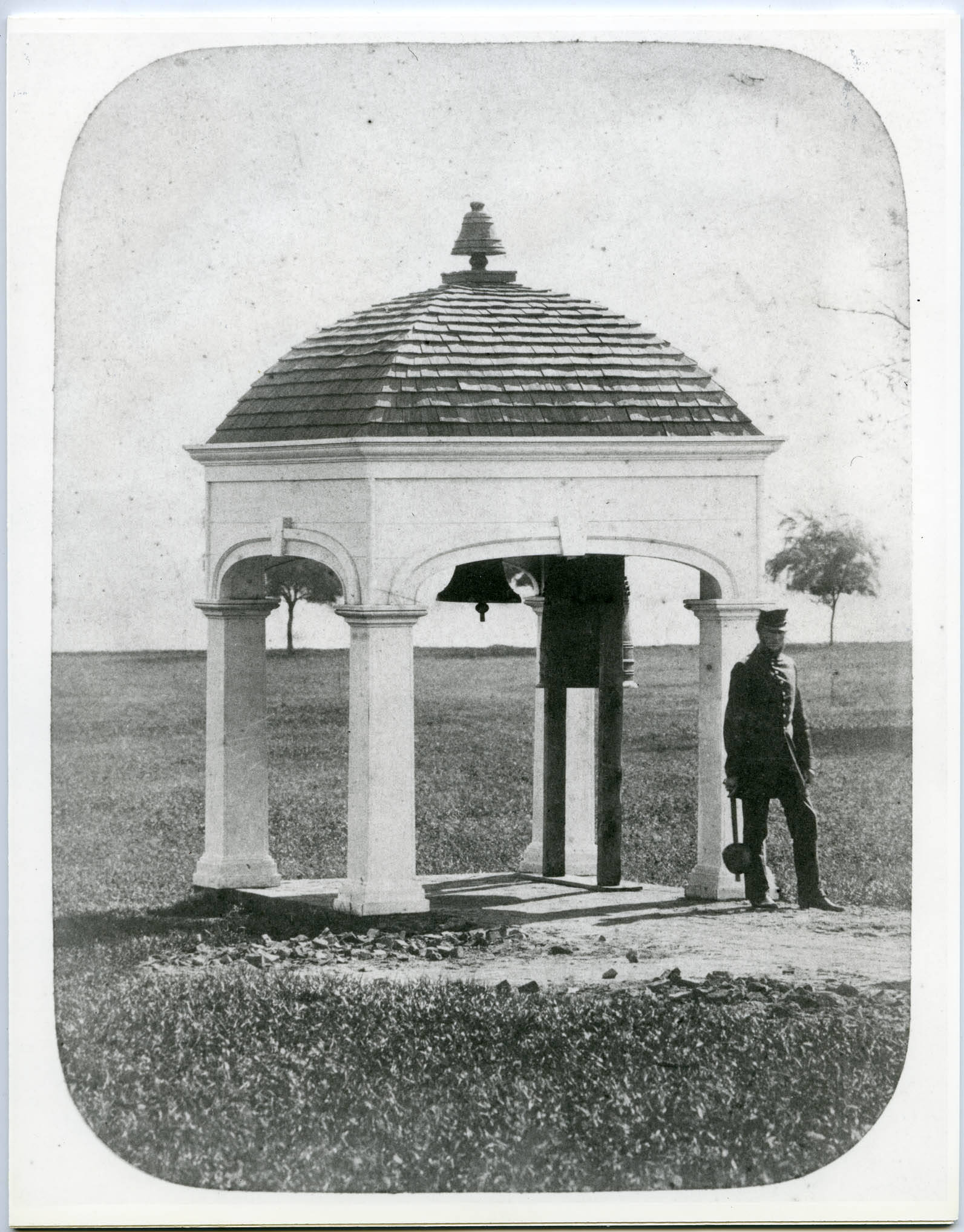 |
| The Japanese Bell in its first belfry, 1860. |
This beautiful bell has been founded and hung in the tower of the temple. It will awaken dreams of superstition. If one will bear in mind to act rightly and truly, and the lords and ministers will do justice in a body, the barbarians will never come to invade. The sound of the bell will convey the virtue of Fushi, and will echo like the song of Tsuirai, and benevolence of the lords will continue forever like these echoes.
In November 1852, President Millard Fillmore designated Commodore Matthew C. Perry, at the time Commander of the US East India Squadron as plenipotentiary with a mission to open Japanese ports to American trade. During the mission’s second visit to Japan on July 12, 1854, the regent of the Lew Chew Islands, now called the Ryukyu Islands, presented the bell to Perry in an exchange of gifts. Perry passed away on March 4, 1858, and in fulfillment of the late commodore’s wish, his widow presented the bell to the Naval Academy on January 12, 1859.
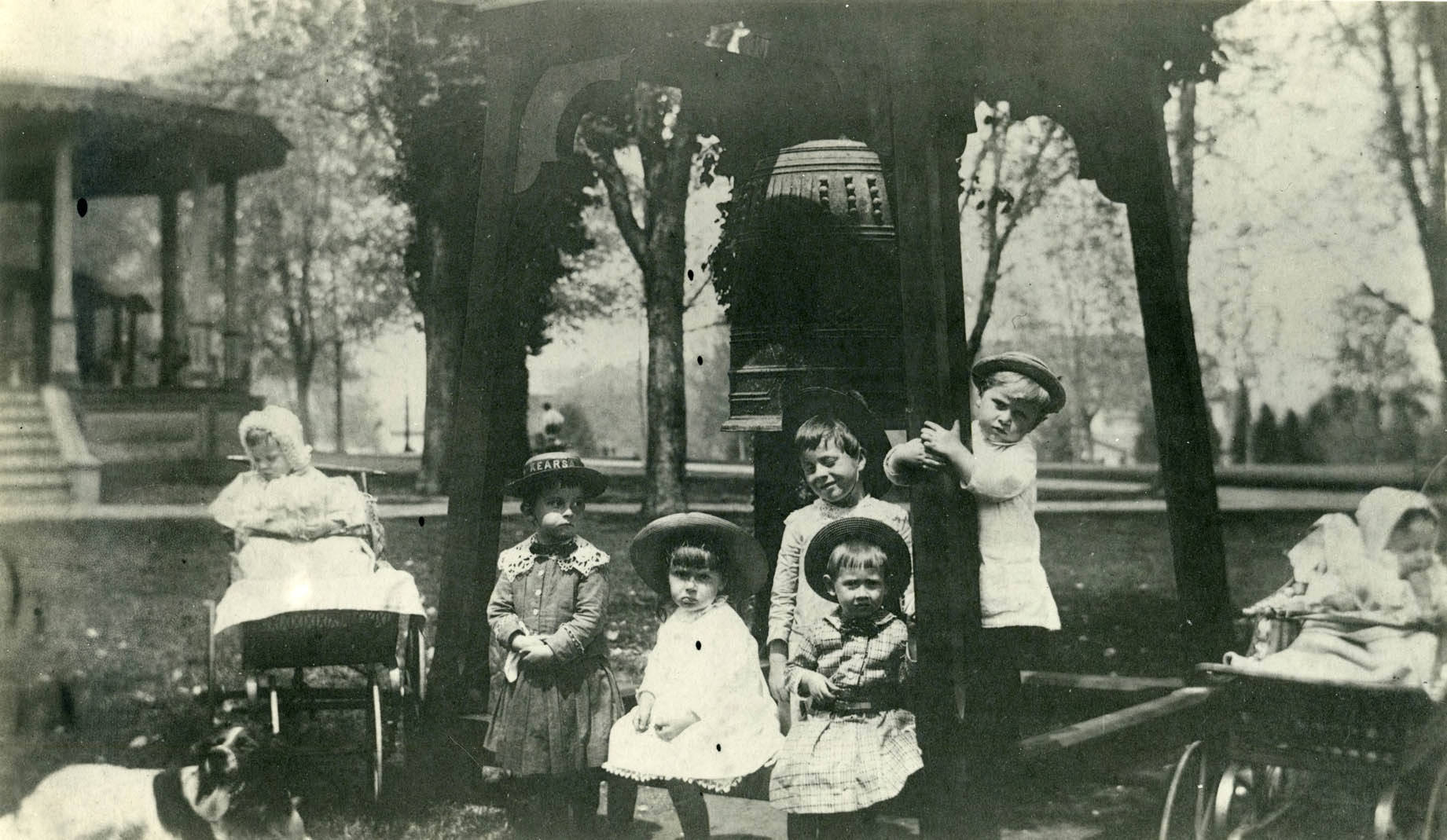 |
| The Japanese Bell surrounded by children of Naval Academy faculty on Lovers' Lane, 1886. |
The bell was originally mounted on the Yard in a freestanding belfry containing another smaller bell near the superintendent’s residence on the parade grounds. Between 1869 and 1870, it was moved to a new belfry just off Lovers' Lane. In 1900, a tradition was born when the football team's captain rang the bell eleven times to signify the number of points scored by Navy in its victory over Army. A clapper crafted from wooden pews in the academy’s second chapel was used until a Japanese clapper was presented to the Naval Academy by the governor of Okinawa in 1956.
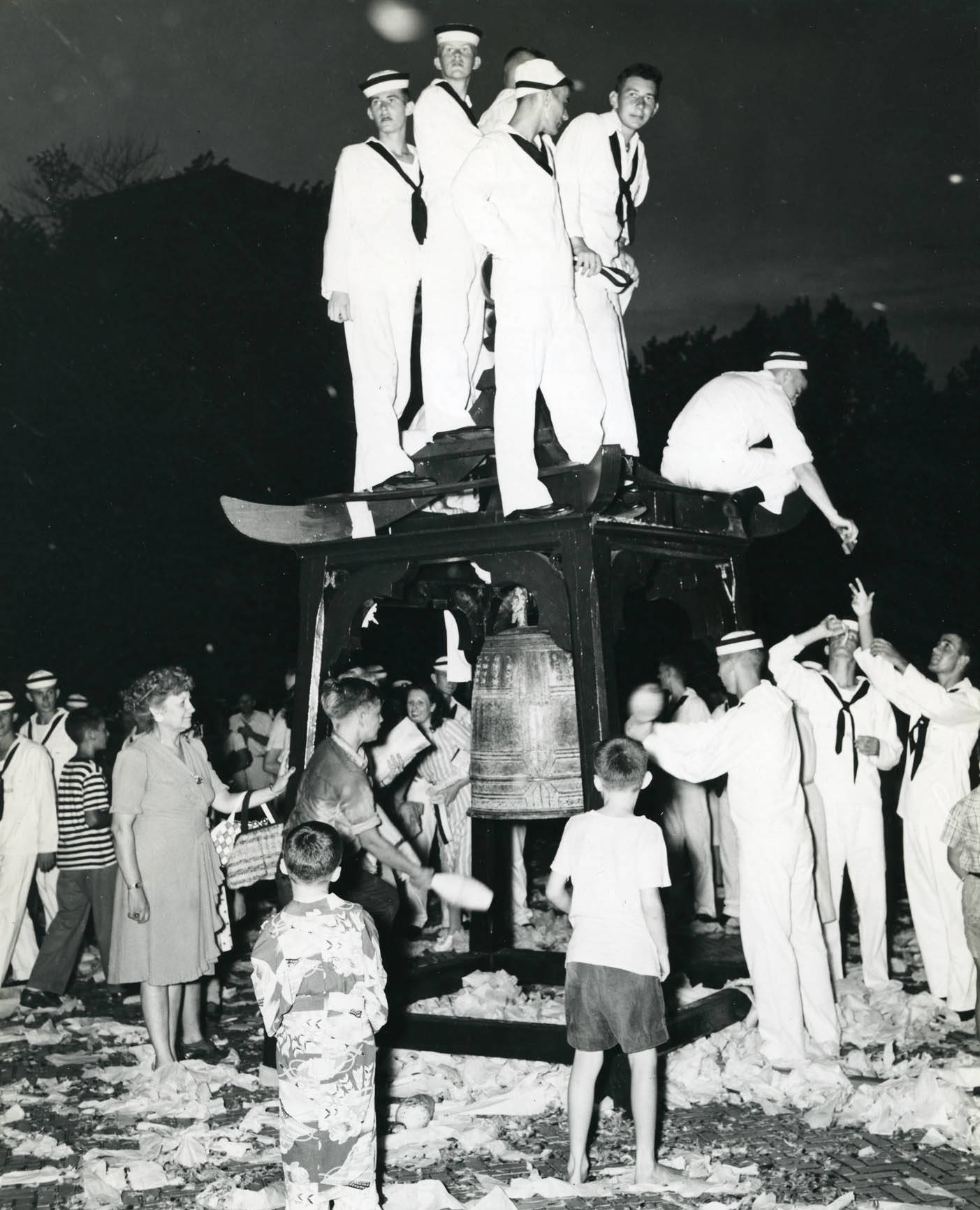 |
| Midshipmen celebrating news of Imperial Japan's surrender, August 14, 1945 |
At the beginning of surrender negotiations between the Japanese Empire and the United States on August 11, 1945, Superintendent John R. Beardall had the bell moved to its current location in front of the main entrance to Bancroft Hall. He also published a brigade order authorizing midshipmen to celebrate the impending peace announcement, and a special midshipman watch was quickly posted to strike the bell immediately upon receiving the news. Around 7 p.m. on August 14, the awaited news arrived and, in the resultant jubilation, midshipmen struck the bell with anything on hand including the clapper, garden rakes, dumbbells, and tenpins, cracking the bell.
On July 6, 1987, the original bell was returned to Japan at the request of the governor of Okinawa. Secretary of the Navy James H. Webb Jr., oversaw the bell's return personally during a tour of the Pacific. Presently, the bell is on display in the Okinawa Prefectural Museum. A replacement bell donated by the same Okinawan governor was installed in the original’s place alongside the bell of the USS Enterprise.
Category: History, Special Collections & Archives