
FSAE NASCAR
POSTED ON: Wednesday, July 1, 2026 9:54 AM by MC2 Hannah K. Craig
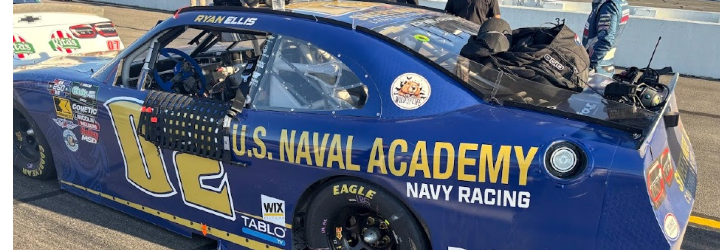
On June 13 Young's Motorsports driver Ryan Ellis hit the track in the U.S. Naval Academy Racing #02 race car for the O’Reilly’s Auto Parts Series, MillerTech Battery 250 NASCAR race at Pocono Raceway in Long Pond, Pa. Midshipmen from the Naval Academy’s Formula SAE (FSAE) team attended the race to represent the Naval Academy and Navy Racing Team to further their understanding and interaction with professional engineers.
“We were very excited to have the No 02 car at Poconos Raceway represent our institution,” said Lt. Gen. Michael Borgschulte, 66th Superintendent of the United States Naval Academy. “Motorsports and the military are cut from the same cloth. We share the same operational DNA: elite engineering, high-stress decision making, tightly choreographed logistics, and athletes who perform at the edge of the human and machine limits. We see this as a natural relationship that we hope to build upon.”
The connection between motorsports and military service was one that resonated throughout the weekend for the midshipmen in attendance.
“Whether you're on a racetrack, cockpit, or bridge, success comes down to preparation, trust in your team, and executing when it matters most,” said Ens. Gabriel Iglesias, a FSAE race team member from the Class of 2026.
Both NASCAR and the U.S. Navy and Marine Corps rely on advanced engineering, precise planning, efficient logistics, and the ability to perform in demanding, high-pressure environments where teamwork and attention to detail are essential.
“They really go hand in hand,” said the FSAE faculty adviser Lt. Cmdr. Kevin Burnett. “Whether you're preparing a race car for competition or supporting a military mission, success comes from the same fundamentals of technical expertise, disciplined execution, strong teamwork, and the ability to perform when the stakes are high.”
For Burnett, the overlap extends beyond engineering. Both motorsports and military organizations depend on coordinated operations, effective resource management, and individuals committed to continuous improvement.
The pursuit of peak performance, whether on the racetrack or in military service, requires dedication to preparation, innovation, and excellence.
“They have a timeline, a budget, team of peers, and chain of command to hold them accountable for meeting deadlines,” said Burnett.
The event was a great opportunity for members of the racing community, midshipmen and other Naval Academy representatives to build a connection.
“The team was extremely proud to have us there and the Naval Academy livery on the car,” said Iglesias.
The race weekend offered visibility for the Naval Academy and its mission of developing warfighters to a national motorsports audience. The weekend also provided midshipmen with an opportunity to highlight common themes between motorsports and military service while introducing attendees to the educational and professional opportunities available through the Academy.
“Every time we made eye contact with a fan, we were thanked for being there, thanked for our service or stopped to exchange stories and experiences,” said Iglesias.
Founded in 1845, the U.S. Naval Academy today is a prestigious four-year service academy that prepares midshipmen morally, mentally, and physically to become professional officers in the naval service. More than 4,400 men and women representing every state in the U.S. and several foreign countries make up the student body known as the Brigade of Midshipmen. U.S. News and World Reports has recognized the Naval Academy as the #1 top public school, #3 national liberal arts college, and #5 best undergraduate engineering programs. From a pool of more than 16,000 applicants, approximately 1,200 earn appointments to the U.S. Naval Academy each year. Midshipmen learn from military and civilian instructors and participate in intercollegiate varsity sports and extracurricular activities. They also study subjects like small arms, drill, seamanship and navigation, tactics, naval engineering and weapons, leadership, ethics, and military law. Upon graduation, midshipmen earn a Bachelor of Science degree in a choice of 26 different subject majors and go on to serve at least five years of exciting and rewarding service as commissioned officers in the U.S. Navy and U.S. Marine Corps. For more information about the Naval Academy, visit www.usna.edu and our social media via linktr.ee/usnavalacademy.
Category: General Interest, Midshipman, People