
Bancroft Hall History
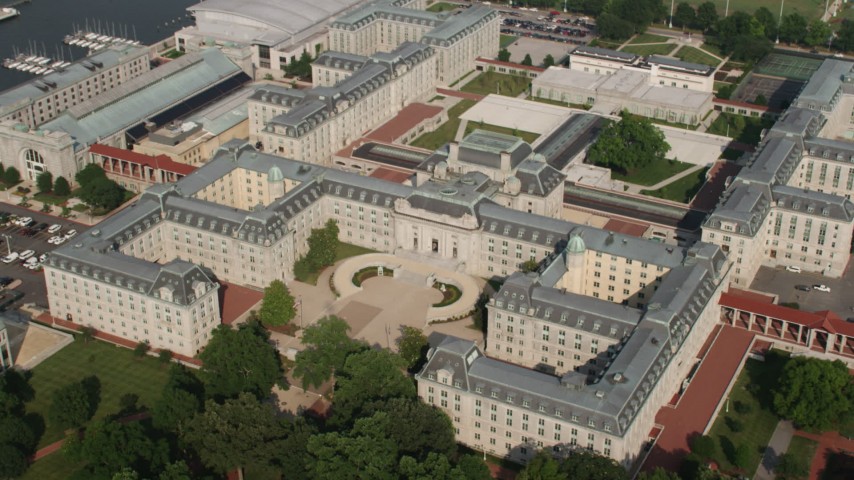
In 1895, businessman Robert Means Thompson (USNA, Class of 1868), directed the renowned architect Ernest Flagg to develop a master plan for an extensively improved Naval Academy.1 A student of the Beaux Arts style of architecture, Flagg created a plan that emphasized "precise axial symmetry," "hierarchy of importance," and "organizational rank." 2 Flagg employed five major design elements, consisting of a quadrangle (Stribling Walk) bordered on all sides by a dormitory (Bancroft Hall) opposite of the academic buildings (Mahan, Sampson, and Carter Halls), a Chapel, and a boat basin (which has since been filled for the construction of Michelson and Chauvenet Halls . . .).
Bancroft Hall (named for Secretary of the Navy George Bancroft, founder of the Naval Academy) is the home to the Brigade of Midshipmen. With 1,639 dorm rooms and 4,663 beds, Bancroft Hall is considered the largest single college dormitory in the world. The building encompasses 33 acres of floor space and has 4.8 miles of corridors (referred to as "passageways").3
Bancroft Hall is comprised of a center section/rotunda to which eight wings are attached. Construction of the first two wings and the center section (Wings 3 and 4) began in 1906 and was completed in 1908. As America's global influence grew in the aftermath of the Great War, so did the Naval Academy. Construction of two additional wings (Wings 5 and 6) occurred from 1918 to 1921. As America's influence continued to grow in the years leading up to the Second World War, Bancroft Hall was again expanded with the completion of Wings 1 and 2 in 1941. Finally, in 1961, Wings 7 and 8 were finished, bringing Bancroft Hall, affectionately known as "Mother B" to Midshipmen and alumni, to her final size.
Midshipmen eat their meals in King Hall (completed in 1953). King Hall is a truly amazing facility, able to serve 4,500 meals at one sitting in less than 10 minutes (13,500 meals served daily!). Mitscher Hall, completed in 1968, contains a theater/auditorium and a small chapel for religious services - the Laboon Center, named for Captain John Laboon, a Catholic Chaplain who heroically served with Marines during the Vietnam War. In 2005, the Uriah P. Levy Center was added to Mitscher Hall. The Levy Center includes a Synagogue, conference rooms, and the Honor Court.
Sources:
- United States Naval Academy. Reef Points 1997-1998.
United States Naval Academy: Annapolis. 1997. pp. 99-101. - Bohl, Chip. "The Naval Academy & Annapolis: Baroque and Beaux Arts, Part 1."
Annapolis Home Magazine, Vol. 4, No. 5, 2013.
http://annapolishomemag.com/new/the-naval-academy-annapolis-baroque-and-beaux-arts-part-1
Accessed 15 August 2018. - Reef Points 1997-1998.
United States Naval Academy: Annapolis. 1997. p. 189.
