
Facilities
The 12-meter Satellite Antenna

12-meter satellite antenna on Hospital Point
The most obvious symbol of the SSEL is the 12-meter Minitrack satellite antenna, acquired from the NASA Goddard Network Test and Training Facility in Greenbelt, Maryland in 1989. The 12m satellite antenna can support communications S- and X-band, with a dual feed. This range of available frequencies allows for various types of space operations, from low-earth orbit (LEO) satellites to the starfield. Focused on the core mission of supporting and enhancing the project-based technical education of its midshipmen, the 12m antenna has been used to communicate with satellites and spacecraft, most notably a mid-session communication with Space Shuttle Columbia via the antenna’s amateur Radio Packet Transponder. Within its fenced enclosure, the satellite antenna also includes a fiber-optics to the SSEL Satellite Mission Operations Center, employing remoter operations to point the dish and uplink commands/downlink data. The enclosure includes a hydraulic manlift to allow full access to all parts of the mechanical and electronic workings of the dish.
The 12m satellite antenna is currently undergoing refurbishment and is expected to resume operations in 2026.
Rooftop Antenna Farm

Antenna Farm on Rickover Hall Rooftop
The rooftop antenna farm contains four antenna platforms with cables and wires running to the Satellite Mission Operations Center (SOC) in SSEL in Rickover Hall, as well as an outdoor telecommunications cabinet. The antennas on two of the rooftop platforms are dedicated to the USNA educational mission and are controlled by the students in the SOC to operate space assets, using either a manual, knob-turning transceiver-based ground station or a the state-of-the-art software-defined radio ground station system. The other two rooftop platforms house antennas that form a node in the Mobile CubeSat Command and Control (MC3) Ground Station Network, a community-based U.S. government ground infrastructure for small satellites. The dual sets of antennas allow the midshipmen to learn satellite operations in an hands-on educational environment while observing real-world, mission-critical satellite operations.
The Rickover rooftop houses additional omnidirectional antennas at HF, VHF and UHF frequencies for use by Extracurricular Activities, such as a the Midshipman HAM RADIO CLUB (W3ADO) and i5. USNA also provides an APRS digipeater from the VHF eggbeater antenna on the Rickover roof.
Satellite Mission Operations Center

Satellite Mission Operations Center in Rickover Hall
The Satellite Mission Operations Center (SOC) consists of the satellite ground station communications systems, as well as a large video wall. The rooftop antennas antenna dish connect to the communications equipment via cables that run from the roof and into the SOC. The USNA SOC serves three separate missions, each of which requires a specific set of communications equipment.
Primarily, the SOC provides a hands-on educational experience in satellite operations for all midshipmen in the astronautical track of the Aerospace Engineering major throughout the curriculum, as well as for those midshipmen in other engineering majors whose research involves communications systems that overlap with satellite communications. For this mission, the rooftop antennas connect to both old-school transceivers and terminal node controllers and to software defined radios. The operations range from knob-turning radios with button-operated antenna rotors to software-controlled transceiver/rotor controllers to software-defined radio automated operations.
As a subset of the educational mission of the SOC, USNA SSEL collaborates with other service academies in the operation of student designed-built-launched small satellites. The SOC has a remote operation setup that is linked to the United States Air Force Academy (USAFA), which allows USNA midshipmen to operate USAFA satellites remotely. Inter-service collaboration ensures an experienced and trained cadre of newly commissioned officers in all branches of the armed forces who can provide technical capabilities in space operations and protect US space interests.
The SSEL SOC also provides ground station and operational capabilities in the Mobile CubeSat Command and Control (MC3) federated network of satellites and antennae, with the ability to expand to other Department of Defense (DoD) networks. The MC3 operations have a dedicated computer system within the SOC.
The USNA SOC contains a large video wall with eight monitors. The video wall is connected to both the SOC computers and antenna surveillance cameras on the roof, and is used for situational awareness of rooftop antenna, satellite ground track displays, orbit information, and visual organization of data received from downlink signals. Its flexible infrastructure can pivot quickly for additional educational needs such as large group training, customer conferences, and special operations.
NASSP Operations
 |
| 2024: RSat has two robotic arms fitted with claws and is intended to advance the use of robotic assistance on future space missions. RSat was launched on November 7, 2022 from NASA Wallops Space Flight Center to the International Space Station as a payload, and operated for 50 hours from January-April 2024 by the Midshipmen Space Operations (MSOPS) team in SSEL. |
Educational Operations
 |
 |
| 2/C Aerospace Engineers track satellites | 1/C RoboticsEngineer uses SOC for Capstone |
Testing/Qualification Facilities
The Astronautics Laboratory spaces are designed to thoroughly test space-grade satellites and flight-ready rockets.

(From Left to Right): Vibration Table, Solar Simulator, Thermal Chamber, Thermal Vacuum Chamber
The Vibration Table can shake along one axis and can be oriented horizontally or vertically during vibration testing for full three-dimensional vibrational analysis.
The Solar Simulator provides illumination that approximates sunlight with respect to spectral match and spatial/temporal uniformity.
The Thermal chamber that can expose over a cubic foot of experimental volume to temperatures from -60C to over 250 C. Access ports are provided for test equipment and instruments.
The Thermal Vacuum chamber that can simulate the vacuum of space while also providing radiant heat similar to the sun and radiative cooling similar to the blackness of space at nearly -70 degrees C.
Fabrication Facilities

Satellite Capstone Design and Fabrication
The Satellite Capstone Team has a dedicated design and fabrication space. The main design area contains standard lab tools, test equipment, space-tolerant and space-rated components, eight workbenches, two CAD stations, and a conference table.
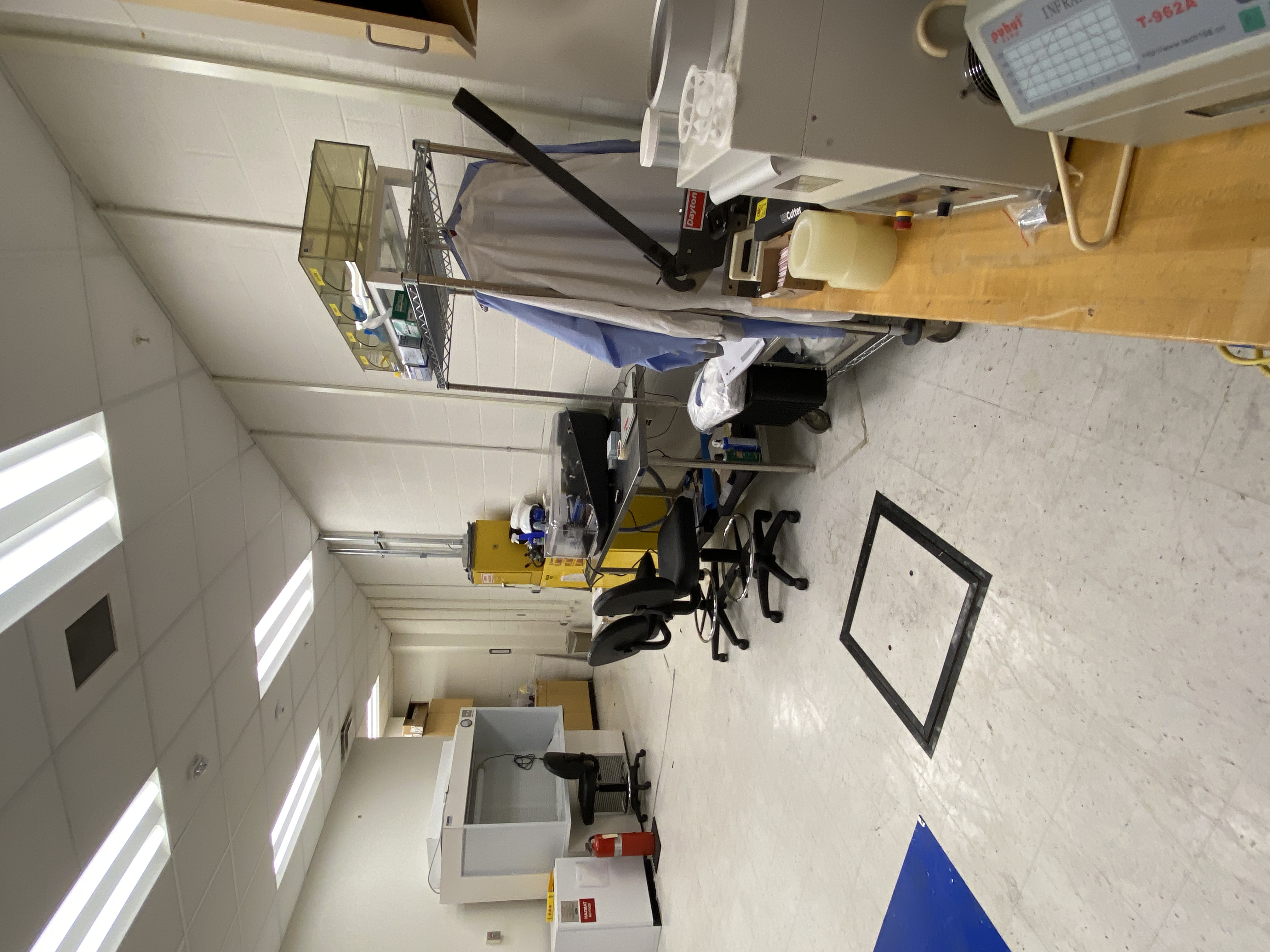 Satellite Capstone Specialized Equipment Room
A separate design area contains specialized equipment and materials, including a fume hood, HAZMAT cabinet and refrigerator, a centrifuge, infrared heater, ultrasonic cleaner and desoldering station. Circuit board fabrication stations include a PCB CNC Milling Machine and a PCB Etching System.
 Rocket Capstone Room
The Rocket Capstone Team has a dedicated design and fabrication space, which contains standard level-3 magazine, specialized tools, lab equipment, safety and personal protective equipment, and HAZMAT storage.
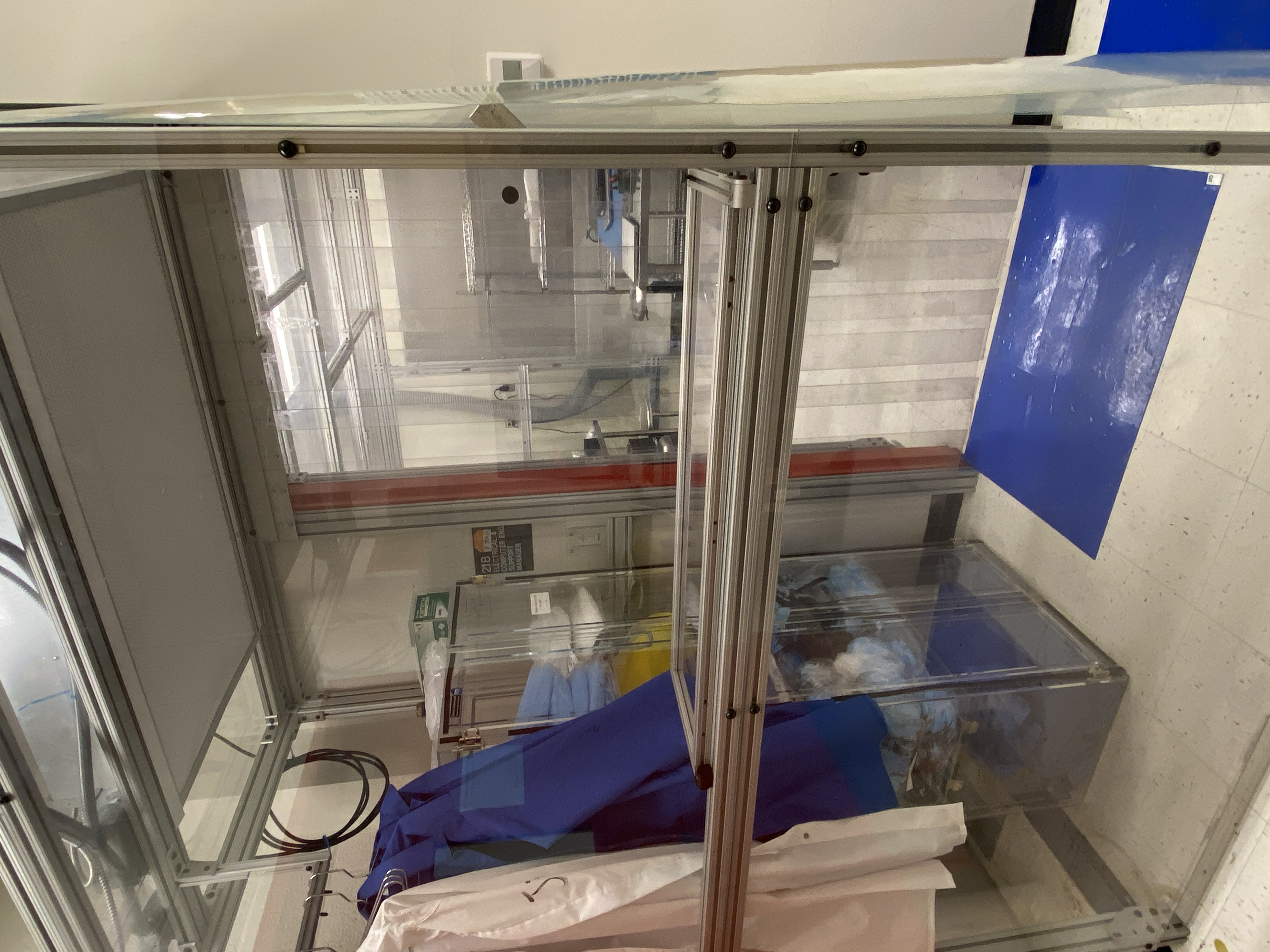
Clean Room
The 10'x13' foot clean room is located in our midshipmen Capstone Room, and contains two workbenches, storage, shelving, an air conditioning unit and sticky mats. An anteroom houses the clean room suits, and a pre-cleaning station. This room can maintain cleanliness to class 100,000 or, with special care, down to 10,000.

Tool room
The tool room provides midshipmen access to power tools, measuring devices and hand tools, 3D printers, printed circuit board printers, cool laminator, solar panel cutter, a hopper sink and additional research workstations that are monitored by SSEL laboratory technical staff. Independent research projects are conducted in this space as well.
