
Programs
The vision of the Department of Aerospace Engineering at the Naval Academy states that midshipmen Conceive-Design-Implement-Operate complex mission-effective aerospace systems in a modern, team-based environment. In the Astronautics Track, this vision is implemented via DoD customers for whom students design, build, and deliver operational UAVs and spacecraft. These design/build teams meet with their customers several times per semester to ensure the vehicles will satisfy the design requirements. The Small Satellite Program Team delivers spacecraft for launch, on time mission-ready to fly on manned space vehicles, coordinating frequent visits to the launch integration contractor/launch facility. The Rocket Team competes in the NASA Student Launch Program, a research-based experiential exploration activity focused on the development of rocket propulsion systems that meet NASA research objectives.
The Naval Academy Small Satellite Program (NASSP)
The Naval Academy Small Satellite Program began in 1999 with a goal of creating a project-based learning experience within the Aerospace Engineering Department. The NASSP allows midshipman to design, fabricate, integrate, test, launch and operate micro-satellites. Since 2012, NASSP has focused on CubeSats, which are research satellites that provide a low-cost platform to test satellite technology. CubeSats are made of units (U's) that measure 10 cm on a side and have a maximum per-U mass of 1.3 kg. Via NASA's CubeSat Launch Initiative that provides launch opportunities auxiliary layloads on planned rocket launches, USNA Midshipmen have sent 18 satellite payloads to space, include eight CubeSats.
The first seven USNA CubeSats were capable of Automatic Packet Reporting System (APRS) communication, a real-time digital communication system developed by Bob Bruninga to map Navy position reports. APRS is a 2-way communication satellite in the Amateur Satellite Service. It can be used around the world by any duly licensed amateur radio operator on land, on the sea or in the air. All communications are captured by volunteer ground stations around the globe and made available on its public web sites. The midshipmen can also use the USNA Satellite Mission Operations Center to communicate directly with their satellites. The eight CubeSat, RSat, was hosted on the International Space Station as a scientific payload in the Microgravity Science Glovebox laboratory, and operated for 50 hours from January-April 2024 by the Midshipmen Space Operations (MSOPS) team in SSEL.
The USNA Aerospace Engineering Department has the space qualification test apparati needed to fabricate and test a satellite and prepare it for flight. The NASSP allows aerospace engineering majors to experience the complete engineering design process while incorporating additional engineering skillsets (electronics, process, reliability, structures and materials engineering), programming and and systems integration.
Current CubeSat Projects
 |
 |
| Satellite: OSPREY VAPORSAT Launch: 2026 Mission: 2U payload for NASB, designed to use commercially available, off the shelf materials to make a passive thruster that extends the on-orbit lifetime for CubeSats at a 250 km altitude orbit. |
Satellite: USNA-16 Launch: Fall 2025 Mission: Modular CubeSat, with 1U satellite bus (Naval Academy Standard Bus: NASB) and payload integration for two externally-developed payloads: USAFA dosimeter and UMD radio. |
SATOPS: USNA Satellites in Orbit
 |
| Satellite: PCSAT Launch: 2001 Mission: provides two-way hand-held communications |
Historical USNA Satellites
 |
 |
 |
 |
|
Satellite: Sapphire |
Satellite: PCSAT-2 Launch: 2005 Mission: ISS Solar Cell experiment; telemetry, command and control |
Satellite: ANDE Launch: 2006 Mission: study space atmosphere; determine safety of using internal lithium batteries |
Satellite: RAFT Launch: 2006 Mission: provide voice receiver for NSSS; voice transponder for MARScom, USNA boats |
 |
 |
 |
 |
| Satellite: MIDSTAR Launch: 2007 Mission: supports Space Program Testing payloads |
Satellite: ParkinsonSAT Launch: 2005 Mission: relay for remote sensors; gradient gravity boom |
Satellite: DRAGONSat Launch: 2013 Mission: first USNA CUBESat; passive stabilization |
Satellite: USS Langley Launch: 2015 Mission: on-orbit Internet server capability |
 |
 |
 |
 |
| Satellite: PSAT Launch: 2015 Mission: on-orbit operation of micro-cathode arc thrusters |
Satellite: BRICSAT-P Launch: 2015 Mission: amateur radio multi-user text messaging |
Satellite: PSAT-2 Launch: 2019 Mission: SSTV-downlink camera images, digital uplink-voice downlink |
Satellite: BRICSAT-2 Launch : 2019 Mission: digipeater, thruster experiment |
 |
 |
| Satellite: RSAT-P Launch: 2016 Mission: 3U CubeSat prototype to demonstrate on-orbit inspection, diagnosis and repair of malfunctioning spacecraft |
Satellite:PSAT-3 Launch: COVID-delayed, at USNA Mission: duplicated PSAT2 with PPOD size payload, on upperstage rocket body |
Hosted on ISS
 |
 |
 |
| Satellite: QIKCOM-1 Launch: 2017 Mission: terrestrial APRS alert beacon on ISS |
Satellite: QIKCOM-2 Launch: 2018 Mission: APRS Touch Tone relay system |
Satellite: RSat
|
USNA Rocket Team
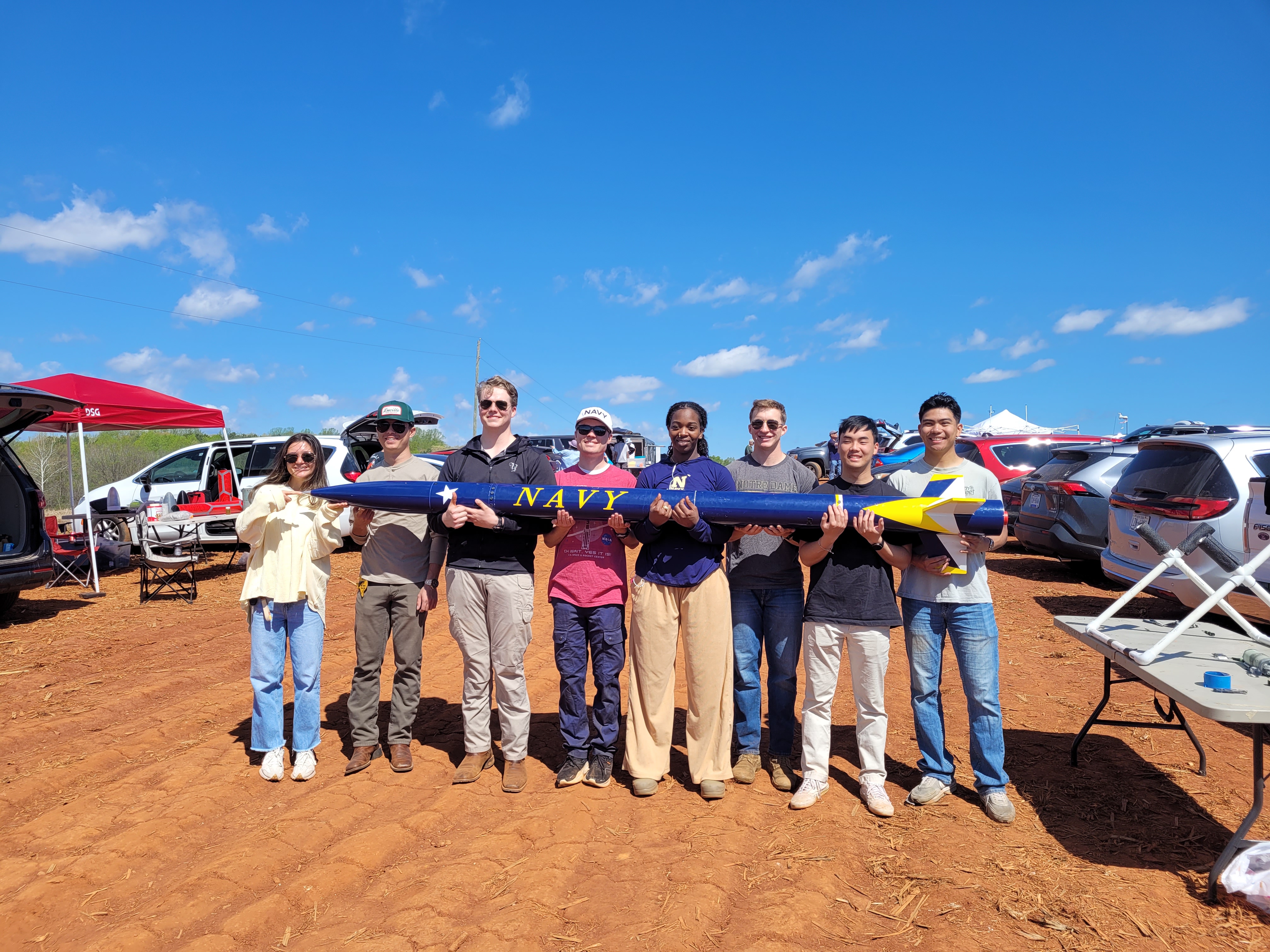
Navy Rockets was founded in 2014 as a hands-on senior design team at the United States Naval Academy, to compete in the annual NASA University Student Launch Initiative. The midshipmen on The Rocket Team design, build, test and fly a launch vehicle with a payload that directly supports NASA research objectives. The Team also designs and builds a ground station to record launch data.
In addition to principles of aerospace engineering, Rocket Team members become proficient in drafting and CAD design, fabrication of composite materials, structural analysis, aerodynamic analysis, and coding. The engineering design process for the Rocket Team includes: 1) proposal writing, 2) preliminary and critical design reviews with subject matter experts, 3) subscale test launch(es), 4) flight readiness reviews, 5) full-scale test launches, and 6) competition in Huntsville, Alabama in April (if selected).
The USNA Aerospace Engineering Department has fabrication capabilities, wind tunnels, and test equipment, which the midshipmen use to build, evaluate and validate the rocket for test flights. Subscale test launches occur at Hospital Point at USNA. Full-scale launches are carried out offsite at launch fields located on the Maryland Eastern Shore or in Central Virginia.
 |
|
Rocket Team 2026 Mission: Design, build, and launch a rocket (target height 4000-6000 ft AGL) and deploy a payload during descent that: 1) landed 4 STEMnauts safely; 2) tested a soil sample at the landing site; and 3) stored the soil data for later analysis. |
 |
 |
 |
| Rocket Team 2025 Mission: Design, build, and launch a rocket (target height 4000-6000 ft AGL) while flying a payload equipped with a Radio Frequency Transmitter that will communicate several pieces of information about the landing site to a designated receiver,including the survivability of four STEMnauts aboard the rocket. | Rocket Team 2024 Mission: Design, build, and launch a rocket (target height 4000-6000 ft AGL) with a lander payload that deploys mid-air, lands on the ground without a parachute, and is reusable to relaunch on the same day without maintenance, repairs or modifications. | Rocket Team 2023 Mission: Design, build, and launch a rocket (target height 4000-6000 ft AGL) with a payload that deploys a camera system upon landing. The payload must follow RF commands to take pictures, rotate 360 degrees, and apply various filters. |
 |
 |
 |
| Rocket Team 2022 Mission: Launch, recover, and design payload; payload autonomously transmits rocket landing location |
Rocket Team 2020 Mission: Launch, deploy payload; payload travels to collect 10 mL of "lunar ice" sample, then navigate with sample on vehicle |
Rocket Team 2019 Mission: Launch, separate,land and deploy payload; deployment search pattern at altitude; beacon deployment |
|
|
|
|
|
Rocket Team 2018 |
Rocket Team 2017 Mission: Launch, target detection |
Rocket Team 2015 First service academy to compete in NASA Student Launch Initiative |


