Electrical Engineering
The disicpline and the major
Electrical engineering is a dynamic engineering discipline that focuses on harnessing electrical energy to drive power systems, transmit information, and control advanced technologies. It is a field of great breadth, encompassing topics as diverse as electronics, signal processing, power systems, communication systems, antennas, RADAR, renewable energy, and electric transportation systems. Electrical engineers design the physical systems that sense, communicate, and power the modern world.
The electrical engineering major provides a rigorous engineering foundation in circuit analysis, digital logic systems, semiconductor device electronics, power systems and rotating machinery, electromagnetism, and microprocessor-based design. Building on this foundation, students learn how to design, analyze, and implement complex electrical systems, such as advanced RADAR and sensor arrays, renewable energy microgrids, autonomous electric transportation, and secure communication networks. Upper-level coursework and hands-on experiences dive further into semiconductor fabrication, device prototyping, engineering optics, laser engineering, power conversion, wireless communications, digital signal processing, and biomedical data science.
Midshipmen participate in hands-on laboratory work beginning their 3/C year, and the program culminates in a core ECE-focused capstone design sequence. This sequence integrates the many hardware and analytical skills acquired in preparatory courses, requiring students to design, implement, test, and demonstrate a significant project. These capstone projects provide deeply meaningful, real-world problem-solving experiences that showcase our students' innovation and capabilities, thoroughly preparing them for impactful careers.
Opportunities
Our department is highly committed to supporting midshipmen as they balance rigorous academic requirements with the Brigade's diverse opportunities. Electrical engineering majors routinely and successfully compete as varsity student-athletes, complete language minors, participate in high-impact summer internship placements, and spend semesters abroad or at other service academies.
The Navy and Marine Corps increasingly require officers with deep technical expertise to lead the development, integration, and security of advanced electrical and communication platforms. We prepare graduates for the complex challenges of the modern warfighting space, as well as the defense and private sectors, by adopting modern engineering techniques and providing guided, early exposure to emerging technologies, including the effective use of Generative AI (GenAI).
Because our graduates possess deep problem-solving skills and a thorough technical background, they are equipped to excel across all operational warfare specialties. The electrical engineering major also provides an exceptional technical foundation for continued, specialized study at the Naval Postgraduate School (NPS) or other premier graduate-level academic institutions, as well as opening doors to successful civilian careers.
Considerations for those who might be interested in this major
Midshipmen considering the electrical engineering major should have a strong interest in pursuing an engineering career that relies on advanced electrical systems, power, and signals. It is ideal for problem-solvers who possess a genuine love for learning and a passion for implementing new concepts through hands-on activities.
The curriculum is highly experiential, with the majority of courses featuring a dedicated laboratory component. Most classes culminate in a final project that integrates the skills acquired in earlier, smaller labs. Our curriculum is interconnected; labs and design challenges frequently build upon one another and span across multiple courses. Well before reaching their 1/C capstone projects, students engage in open-ended, constraint-based mini-projects, allowing them to master constraint optimization and full lifecycle execution from the very beginning of their academic careers.
Beyond technical aptitude, the ideal electrical engineering student is someone who thrives in a close-knit, collaborative environment. Our department prides itself on maintaining a relatively smaller, supportive community with a family-like mindset, where faculty and midshipmen know each other well and are deeply committed to one another’s success.
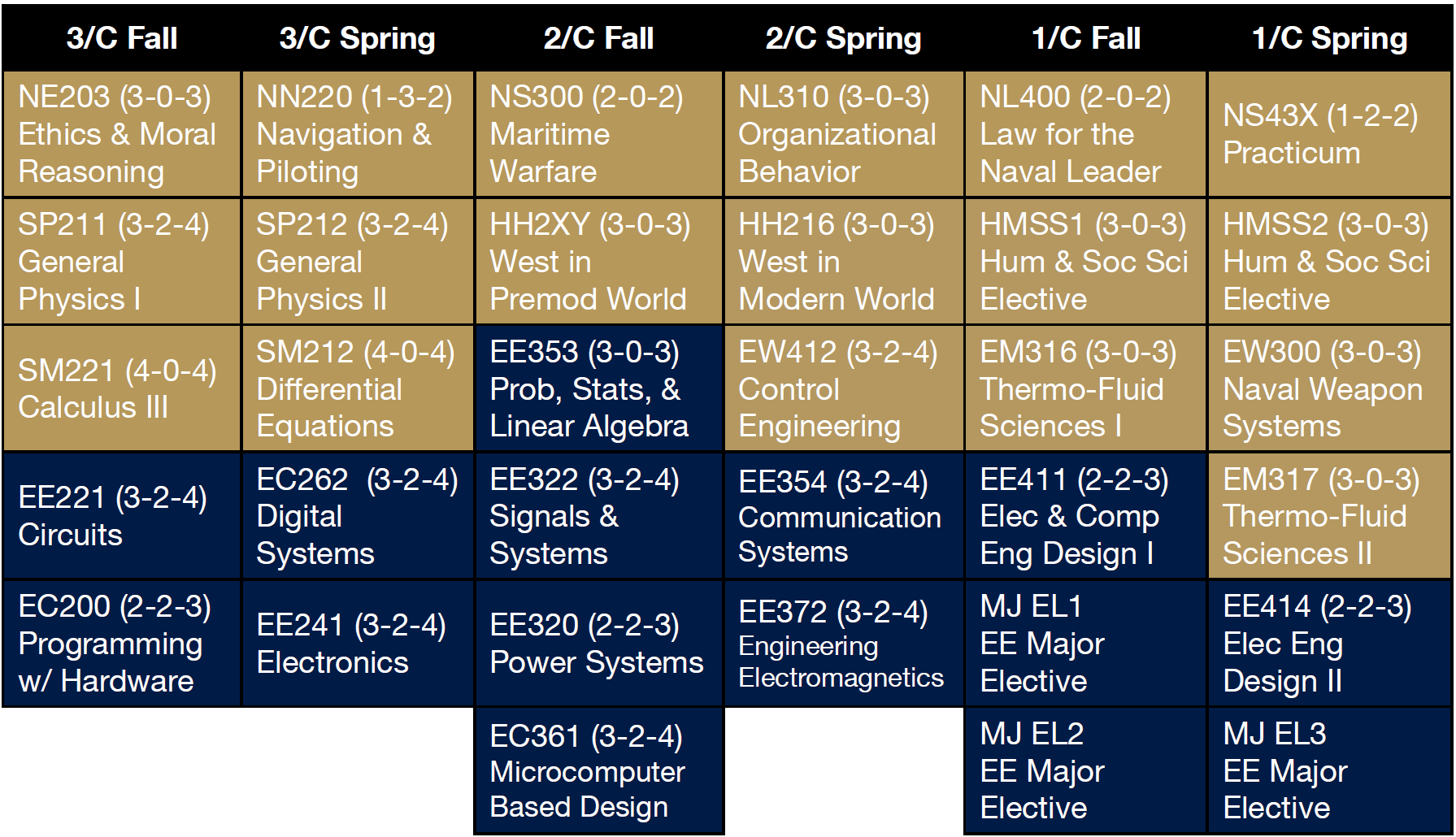
Electrical Engineering - Core Major Courses
- EC200 Introduction to Programming with Hardware Applications
- EE221 Circuit Analysis and Design
- EC262 Digital Systems
- EE241 Electronics I
- EE353 Probability, Statistics, and Linear Algebra for ECE
- EE322 Signals and Systems
- EE320 Electric Power Systems Fundamentals
- EC361 Microcomputer-Based Design
- EW412 Control Engineering for Electrical Engineers
- EE354 Modern Communication Systems with Cyber Applications
- EE372 Engineering Electromagnetics
- EM316 Thermo-Fluid Sciences I
- EE411 Electrical & Computer Engineering Design I
- EM317 Thermo-Fluid Sciences II
- EE414 Electrical Engineering Design II
Electrical Engineering - Major Elective Courses
- EE420 Electric Machines and Drives
- EE432 Digital Signal Processing
- EE433 Wireless and Cellular Communications I
- EE435 Biometric Signal Processing
- EE440 Brain-Machine Learning
- EE444 Power Conversion
- EE451 Electronic Properties of Semiconductors
- EE472 Fiber Optical Communications
- EE473 Principles of RADAR and Electronic Warfare
- EE474 Engineering Optics
- EE475 Laser Fundamentals