

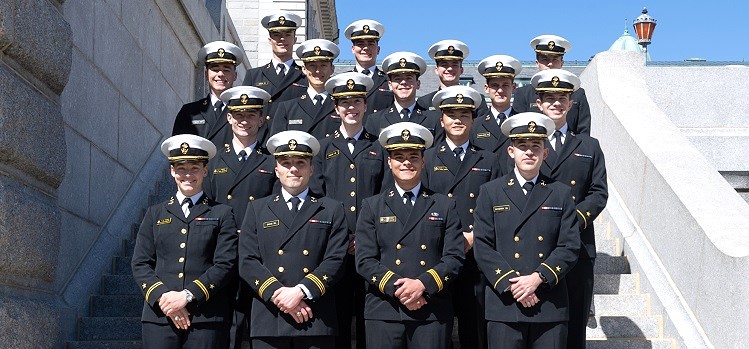
Trident Scholar Abstracts 2025
Troy J. Boland
Midshipman First Class
United States Navy
Additive Manufacturing Methods for Fabrication of Split Ring Resonator-Based Frequency Selective Surfaces
Multiple fabrication methods for split ring resonator (SRR) and complementary split ring resonator (CSRR) based frequency selective surfaces (FSS) were explored. A CSRR FSS geometry was fabricated using 3D printed plastic parts via fused deposition modeling (FDM) and stereolithography (SLA), then made conductive with water-based silver paint. Resonance near the design frequency was achieved, though performance degraded due to reduced conductivity and dielectric losses from the printing process. This demonstrates a rapid, cost-effective approach to prototyping FSS unit cells.
Frequency tunability was investigated with a mechanically stretchable SRR FSS. Silver ink was screen-printed onto a silicone substrate and thermally cured. Stretching altered SRR geometry, tuning the resonance. The response was not fully reversible, likely due to cracking, and exhibited insufficient rejection depth. Aerosol Jet Printing (AJP) and flexible SLA substrates were attempted but failed due to insufficient print height and excessive loss, respectively.
A third method introduced tunability by injecting liquid metal into a 3D-printed microchannel across the resonator gap. A near-linear frequency shift was observed prior to saturation, followed by a discrete jump. Pre-saturation performance was practical, though limited by dielectric losses. This approach demonstrates strong potential with further material refinement.
FACULTY ADVISORS
Assistant Professor Connor Smith
Electrical and Computer Engineering
Professor Hatem ElBidweihy
Electrical and Computer Engineering
Professor Charles Nelson
Electrical and Computer Engineering
Conrad P. Davis
Midshipman First Class
United States Navy
Salt Marsh Hydrodynamics to Inform Beneficial Use of Dredged Material for Coastal Resilience
A Beneficial Use of Dredged Material (BUDM) project at Scotch Bonnet Wetlands, in Stone Harbor, NJ provided a unique opportunity to measure hydrodynamic and morphologic conditions in two marsh channels (North and South) before, during, and immediately after material placement. The South Channel experienced no direct placement, while low-lying head areas of the North Channel were infilled. Data were sourced from a combination of deployed instruments, permanent monitoring stations, and field morphological measurements. Pre-placement, the North Channel experienced mean peak velocities of 27.4 cm/s (flood) and 26.2 cm/s (ebb), and mean peak velocities at the South Channel were 22.5 cm/s (flood) and 38.5 cm/s (ebb). Post placement, the North Channel saw decreases in mean peak velocities to 11.3 cm/s (flood) and 11.0 cm/s (ebb). In comparison, the South Channel remained similar to pre-placement flood conditions at 24.1 cm/s and had a minor decrease in ebb to 27.2 cm/s. Results indicate that morphological changes caused by BUDM projects can potentially decrease flow velocities in marsh creeks, which could reduce channel erosion, a step towards understanding their effectiveness at attaining coastal resiliency and marsh restoration goals.
FACULTY ADVISORS
Associate Professor Liliana Velasquez Montoya
Naval Architecture and Ocean Engineering
Associate Professor Victoria Johnson
Naval Architecture and Ocean Engineering
Associate Professor Anna Wargula Zaslov
Naval Architecture and Ocean Engineering
Jeffrey Davis II
Midshipman First Class
United States Navy
Measurement and Modeling of Optical Turbulence through the Near-Maritime Atmospheric Boundary Layer
Optical turbulence, or the variation in index of refraction in the atmosphere, leads to loss of laser beam coherence, which decreases the power received at the terminus of an optical path. It is of interest to a naval commander to know how optical turbulence in the atmosphere is related to readily measurable meteorology. Optical turbulence may be quantified by the refractive index structure function parameter, 𝐶𝑛2. The dependence of 𝐶𝑛2 on height above the surface of the earth in the near-maritime environment (the region where both land and water have a significant effect on the meteorology) is particularly relevant because many naval applications of lasers are performed on slant paths with large height changes within this region. This work compares measurements of slant profiles of 𝐶𝑛2 in the near-maritime atmospheric boundary layer to existing physical models’ predictions of vertical profiles of 𝐶𝑛2 and predicted slant profiles of 𝐶𝑛2 from statistical models. Trained statistical models provided information about the atmospheric surface layer consistent with the physical understanding of the atmosphere. The statistical models had greater agreement than the evaluated physical models with turbulence observations in general and in instances when turbulence is at its highest values within the near-maritime environment.
FACULTY ADVISORS
Professor John Burkhardt
Mechanical and Nuclear Engineering
Professor Cody Brownell
Mechanical and Nuclear Engineering
Professor Charles Nelson
Electrical and Compuer Engineering
Andrzej J. Korlacki
Midshipman First Class
United States Navy
Radiation detectors are essential across various fields, including medicine, energy, defense, and national security. This work explored the feasibility of using commercial, off-the-shelf additive manufacturing technology to produce plastic scintillation detectors by focusing on developing a new resin composed of polyvinyl toluene (PVT) suitable for use in Formlabs Form 4 printers. The experimental resin was composed of vinyl toluene monomer and a photoinitiator. Photoinitiators were chosen for their compatibility with vinyl toluene, sensitivity at the target wavelength of 405 nm, and use in prior research. The photopolymerization of various PVT-based resin compositions was tested in a modified printer setup. The composition of the resin was principally varied by changing the loading and type of photoinitiator used. A small sample of PVT with phenylbis(2,4,6-trimethylbenzoyl) phosphine oxide (BAPO) as the photoinitiator was successfully photopolymerized inside the Form 4, demonstrating the feasibility of using a PVT-based resin in this printer. Additional testing assessed the potential for full-scale 3D printing under standard printer conditions. Future work could iterate upon both the chemical composition of the resin and the printing parameters used during the curing process to further develop additive manufacturing as a viable technique for plastic scintillator production.
Mechanical and Nuclear Engineering
LCDR Joseph Latta, USN
Mechanical and Nuclear Engineering
Assistant Professor Megan Mohadjer Beromi
Chemistry
Midshipman First Class
United States Navy
Modern weather forecasting has made significant progress, but accuracy declines as forecasts extend from days to weeks. This is partly due to gaps in the understanding of tropical atmospheric dynamics, particularly tropical convection on sub-seasonal time scales. Given the global impact of weather, improving this understanding is crucial for more accurate long-range forecasts.
Accordingly, this study examines the relationship between the Madden-Julian Oscillation (MJO)—the primary mode of tropical intraseasonal variability—and six equatorial waves. Using outgoing longwave radiation (OLR) data and a well-established MJO index, MJO variability parameters of amplitude, phase, and seasonality are isolated. By segmenting OLR and wave projected field variables with those MJO variability parameters, relationships between MJO variability, and equatorial wave activity and structure, are quantified.
The findings from this study align with previous research, confirming stronger MJO activity in winter and spring, and the transition of mixed Rossby–gravity (MRG) waves to tropical depression-type disturbances. New results are also identified: for instance, a strong MJO enhances equatorial Rossby (ER) wave strength but does not affect Kelvin waves. Additionally, eastward inertia-gravity (EIG) waves behave like westward inertia-gravity (WIG) waves, regardless of MJO amplitude. These insights contribute to improving sub-seasonal weather prediction models.
FACULTY ADVISORS
Professor Gina Henderson
Ocean and Atmospheric Sciences
Associate Professor Scott Hottovy
Mathematics
Matt T. Marinkovich
Midshipman First Class
United States Navy
Russophone or Russophobe? Language Attitudes Among Young Kazakh Residents in Almaty
Since 1991, Kazakhstan has attempted to strengthen its sovereign national identity through Kazakh language revitalization policies despite the population’s competing visions of the role of language in the independent nation. Although Almaty–the old Soviet capital and largest city–remains predominantly Russophone, a younger generation of Kazakhs displays complex views towards the future of both languages. Using an ethnographic approach through both qualitative and quantitative analysis of interviews conducted in the spring of 2024, this project examines current language attitudes and practices of the city’s young Russophone Kazakhs. Findings show that although respondents still predominantly employ the Russian language in the city, a significant uptick in Kazakh language use demonstrates a newfound urgency to promote a sovereign Kazakh identity following the 2022 January Events and Russian invasion of Ukraine. This perceived shift towards the Kazakh language is notable for its ability to reach the previously disengaged younger population in Almaty, whose attention decades of Kazakh language policy has failed to capture. The results of this research contribute to a new framing of Kazakhstan as an independent state–less centered on the historical legacies of the
‘Post-Soviet’ perspective but rather reflecting the lived experiences and ongoing processes of the nation’s development.
FACULTY ADVISORS
Associate Professor Catherine O'Neil
Languages and Cultures
Associate Professor Joan Chevalier
Languages and Cultures
Midshipman First Class
United States Navy
Improving Machine Learning Deep Sequential Analysis through Recurrent Transformers (ReTrans)
The advent of the machine learning transformer architecture has ushered in an era of artificial intelligence driving innovations across industries. However, large language models have several limitations arising from the underlying structure of the transformer. One issue that has received much attention is transformers’ difficulties with solving problems that require deep sequential reasoning, like math problems. We believe that recurrence, a model directly utilizing prior computational states, is critical for addressing this limitation. Recurrence natively incorporates iterative computation, which is necessary for algorithmic problem solving and deep analysis. Our research incorporates recurrence directly into the transformer architecture. Our goal was to ‘bite the bullet,’ extracting as much performance as possible out of the recurrent computations to justify the bottleneck that they incur. Our architecture, called the recurrent transformer (ReTran), modifies the transformer architecture by introducing recurrence into the self-attention mechanism and replacing the feed-forward neural network with a recurrent long short-term memory network. We tested our architecture against current methods on synthetic arithmetic and Boolean satisfiability datasets. Our method achieves better accuracy while using less memory and energy.
FACULTY ADVISOR
Professor Frederick Crabbe
Computer Science
EXTERNAL COLLABORATOR
Professor Rebecca Hwa
George Washington University
Sean D. O'Boyle
Midshipman First Class
United States Navy
Investigation of Host Protein Cleavage by Neuroinvasive Viruses
Neuroinvasive viruses, such as Zika Virus (ZIKV), West Nile Virus (WNV), and Enterovirus-71 (EV-71), can cause neurological disease. Viral proteases from these viruses have evolved to recognize and cleave target regions in viral proteins, but can also recognize their target sequence in proteins of the organism that is infected; this is the hypothesized origin of their pathogenic interactions. One predicted human protein target is ADGRA2, which protects the blood-brain barrier. The goal of this study is to investigate the cleavage of ADGRA2, ex vivo, by the proteases of ZIKV, WNV, and EV71. ADGRA2 is expressed in A549 human cells, then treated with purified protease (exogenous treatment) or co-transfected plasmids expressing viral proteases (endogenous treatment). Insertional mutagenesis was used to insert a coding sequence to allow for visualization using an antibody. Plasmid constructs for the expression of ZIKV, WNV, and EV71 viral proteases in mammalian cells were synthesized. Cells that express the three viral proteases were induced to express the proteases. The WNV protease was successfully purified. Successful cleavage will be assessed by the visualization of the resulting fragment sizes via western blotting. Results of these investigations will provide new insights into the mechanism and conditions of the pathogenesis of these neuroinvasive viruses.
FACULTY ADVISORS
Associate Professor Ina O'Carroll
Chemistry
Associate Professor Michelle Jamer
Physics
Ψ Owen M. O'Malley
Midshipman First Class
United States Navy
Machine Learning for Underwater Optical Turbulence and Vortex Beam Characterization using Multimodal Synchronous Measurements
The Navy’s focus on laser communications and sensors requires studying optical turbulence, as it distorts laser light. This research characterizes the effect of experimental underwater optical turbulence on vortex beams that carry orbital angular momentum (OAM).
The project employs a novel combination of turbulence characterization methods via synchronous measurements of the pupil-plane and focal-plane intensity and OAM mode sorter. The phase of a reference Gaussian beam is also measured. The statistics of the fluctuations of these measurements are used to calculate the strength of optical turbulence.
Convolutional Neural Networks (CNNs) are developed to analyze snapshots of the beams using one or more of the synchronous measurements. These simultaneously recorded data points form a momentary input for the CNN to predict either the beam's OAM mode (for communications) or turbulence strength (for environmental sensing).
Our results show the synergy of the pupil-plane intensity and phase in the environmental sensing machine learning algorithm, and that the pupil-plane intensity provides more useful information in mode discrimination than the mode sorter. Our work also includes a contribution on using the Gerchberg-Saxton phase retrieval algorithm for vortex beam phase reconstruction in simulations.
FACULTY ADVISOR
Professor Svetlana Avramov-Zamurovic
Weapons, Robotics, and Control Engineering
EXTERNAL COLLABORATOR
Dr. Nathaniel Ferlic
Naval Air Warfare Center
Jillian R. Oncay
Midshipman First Class
United States Navy
Evaluation of Biobased Polyesters in Additive Manufacturing
Biopolyesters are a class of polymeric materials either partially or fully made by living organisms and are attractive due to their hallmark characteristics: biodegradability, biocompatibility, and non-toxicity, of which polylactic acid (PLA) and poly-[(R)-3-hydroxyalkanoates] (PHAs) are prime examples. These materials have garnered interest due to their biocompatibility and as alternatives to petroleum-based polymers employed in the biomedical field. PLA and PHAs form the basis of many FDA-approved biomedical devices, including sutures, surgical meshes, orthopedic pins, and stents. In addition, PLA is the most common biopolyester used in 3D printing technologies (i.e. additive manufacturing - AM). Recently, our research group established a way to augment the capabilities of bacterial PHAs by focusing on the material’s chemical reactivity and introducing an organoazide (-N3) functional groups to produce AzidoPHAs. We hypothesize that a chemically-tractable PHA with material properties compatible with AM may be beneficial for applications such as personalized regenerative medicine. In this project, we demonstrate the proof-of-concept production of a PHA-doped PLA filament and its subsequent use in AM by fused deposition modeling (FDM). We hope to soon test the production of the chemically-modifiable AzidoPHA-doped PLA filament and perform tagging experiments via click chemistry to confirm the filament’s reactivity.
FACULTY ADVISORS
Assistant Professor Atahualpa Pinto
Chemistry
CDR Jonathan Slager, USN
Mechanical and Nuclear Engineering
Zachary Z. Peng
Midshipman First Class
United States Navy
Progress Toward the Development of Microwave-Assisted Concurrent Tandem Catalytic Synthetic Methodologies Involving Copper for the Formation of Biaryl Ethers
Synthetic methodologies are reliable bond-forming reactions that allow chemists to form larger, more complex compounds from smaller molecules. An example of this is the Nobel Prize-winning palladium-catalyzed cross-coupling of aryl halides to form carbon-carbon, carbon-nitrogen, and carbon-oxygen bonds, commonly found in compounds with real-world applications in pharmaceuticals, agrochemicals, and materials. Recently, the MacArthur/Lin group at USNA has been exploring copper-catalyzed cross-coupling reactions of aryl halides using a novel concurrent tandem catalytic (CTC) mechanism. Copper is more earth-abundant than palladium and about four orders of magnitude less expensive. However, it is less effective at facilitating cross-couplings with aryl chlorides and bromides, preferred reactants due to cost and availability; aryl iodides are more reactive and commonly used in copper-catalyzed transformations. The CTC methodology enables copper-mediated cross-coupling of chlorides and bromides by employing two catalytic cycles simultaneously in one reaction vessel. The first transforms the chloride or bromide into an iodide (reaction A), which then undergoes cross-coupling (reaction B). Our work focused on developing CTC etherification to synthesize aryl ethers. We investigated reaction conditions including temperature, ligand, and solvent and found different ligands maximize yields for reactions A & B, suggesting that a mixture of ligands may be advantageous for CTC etherification.
FACULTY ADVISORS
Professor Amy H. R. MacArthur
Chemistry
Professor Shirley Lin
Chemistry
EXTERNAL COLLABORATOR
Professor Lori Watson
Earlham College
Jacob L. Price
Midshipman First Class
United States Navy
Application of Quantum Secure Encryption Algorithms in Bluetooth Tracking Devices
As quantum computers advance, they will have the computational power to break current encryption algorithms like RSA. To defend against future quantum attacks, four quantum-safe encryption algorithms (QSAs) have been proposed as replacements. However, these QSAs face limitations, such as large key sizes and potential privacy risks. Certain non-flexible applications, therefore, need to adapt to create quantum-secure devices.
Bluetooth tracking devices (BTDs) are a specific challenge, as the 27-byte Bluetooth Low Energy (BLE) advertisement frames cannot accommodate the 1568-byte public key of the quantum-safe Crystals Kyber algorithm. This project reworks the BTD encryption scheme to fit these limitations. Method 1 splits the key into 59 27-byte fragments, broadcasted by the BTD and reassembled by a receiver. Method 2 uses identifiers that point to the full key stored on a server.
Our research aids in identifying the best methods for transitioning to a post-quantum security state. Further investigation is needed into quantum-safe protocols, and cryptographers can apply these techniques to safeguard future systems.
FACULTY ADVISORS
Associate Professor Travis Mayberry
Cyber Science
Assistant Professor Ellis Fenske
Cyber Science
LT Sam Teplov, USN
Cyber Science
Tenlea W. Radack
Midshipman First Class
United States Navy
On Terao’s Conjecture: Balanced Multiplicities and Expected Codimension
Terao’s conjecture proposes that there is a deep connection between a matroid (a combinatorial structure), an associated arrangement and an algebraic property called freeness. More specifically, Terao’s conjecture claims that an arrangement’s freeness is only dictated by its associated matroid. The conjecture has been validated for 14 hyperplanes or less, in rank 3. We study the conjecture for rank 3 matroids with 15 hyperplanes. We introduce and prove a non-generalizable, non-recursive formula to efficiently compute the expected codimension for all rank 3 matroids. From work by Wakefield and Yuzvinsky, counterexamples to Terao’s conjecture can be defined as a finite list of rules on the multiplicities of a matroid. There are 232,929 rank 3 matroids with 11 hyperplanes, and 28,872,973 rank 3 matroids with 12 hyperplanes. There is no data on how many rank 3 matroids with greater than 13 hyperplanes exist. The multiplicity balanced matroid definition narrows down the unknown large number of rank 3 matroids with 15 hyperplanes into a size feasible for computation. Using symmetry in the flat interpretation of a multiplicity balanced matroid, we present an efficient algorithm for generating all the possible counterexamples to Terao’s conjecture of rank 3 matroids with 15 hyperplanes.
FACULTY ADVISOR
Professor Max Wakefield
Mathematics
Sebastian G. Scherry
Midshipman First Class
United States Navy
Topic Modeling of Pacific Theater Submarine War Patrol Reports, 1941-1945
Close reading forms the methodological basis for the existing historiography of the submarine war, as exemplified by Clay Blair’s Silent Victory (1975). Blair’s analysis emphasizes how the submarine force overcame poor performance that he attributes to ineffective commanding officers, poor force employment, and defective torpedoes. Digital Tools, specifically topic modeling, offer an opportunity to rethink the traditional approach to historical analysis using distant reading. American submarine patrol reports from the Pacific theater of the Second World War offer a corpus on which to test the utility of this method. The roughly 1500 patrol reports comprise more than 63,000 pages of text. I test whether topic modeling, a tool for distant reading, will surface similar themes to a close reading of the same texts, or whether it will instead suggest new areas for analysis. In my tests, topic modeling validated significant elements of Blair’s interpretation, such as the torpedo problem. However, it also generated topics suggesting the need to take more seriously other elements of the submarine war, such as the debilitating effect a variety of mechanical failures had on submarine readiness. Overall, topic modeling demonstrated its utility for both validating close reading interpretations and opening new avenues for inquiry.
FACULTY ADVISORS
Assistant Professor Abigail Mullen
History
CDR Ryan Mewett, USN
History
Lucas G. Sprio
Midshipman First Class
United States Navy
Analyzing CN Coma Morphology to Investigate Correlations Between Cometary Age and Dynamical Classification
Comets are renowned as fragments leftover from the formation of the solar system. They have been preserved far from the Sun since soon after their formation, marking them as key tools for understanding the nature of solar system formation. This project used a database of 79 previously imaged comets to evaluate how cometary “age” correlates with various morphological properties.
We investigated various properties of comets by analyzing quantitative and qualitative correlations between coma morphological properties, previously published quantitative characteristics, and slope profile values. In particular, we investigated correlations relating coma profile slope values determined for more than 4000 images. A preliminary correlation was identified between the profile slope values and the previously known dynamical classification of comets. This finding suggests that the slope of the coma profiles could serve as a direct indicator of a comet’s dynamical origin.
Almost all research regarding coma morphology has been done on individual comets with large amounts of data available for that singular comet. This is the first analysis of comet morphology spanning a large imaging database in order to further our current understanding of comets and therefore the formation of our solar system.
FACULTY ADVISOR
Assistant Professor Matthew Knight
Physics Department
Brody A. Todd
Midshipman First Class
United States Navy
Support-Free, Zero-Degree Overhang Additive Manufacturing Using a Wandering Center of Motion
This project presents a novel conformal additive manufacturing (AM) method enabling support-free fabrication under a zero-degree overhang constraint. Motivated by the U.S. Navy’s interest in reducing supply chain dependencies, this research explores a cost-effective, material-efficient AM process by leveraging robotic spherical AM constrained to support-free printing. By enforcing a zero-overhang constraint, the method eliminates the need for sacrificial support material used to address structural deficiencies in cantilevered or intricate geometries. A new approach is introduced by dynamically “wandering” the remote center of motion (RCM) during printing, enabling a spherical layering technique capable of fabricating complex geometries without support material. This work derives the wandering RCM method in two dimensions (2D) by analyzing properties of star-convexity to achieve circular layering for arbitrary 2D polygons. A 2D path-planning algorithm is developed to decompose a non-star-convex polygon into multiple “zero-overhang, spherical-print enabled” partitions, yielding a branching, flexible fabrication sequence. Additional analysis explores initial RCM placement and partition ordering to minimize or eliminate nozzle collisions during printing. By integrating computational geometry through an extension of the Art Gallery Theorem, this research presents a feasible pathway for support-free spherical AM in 2D, with future work targeting polyhedral decomposition for 3D implementations.
FACULTY ADVISOR
Associate Professor Michael D. M. Kutzer
Weapons, Robotics, and Control Engineering
