
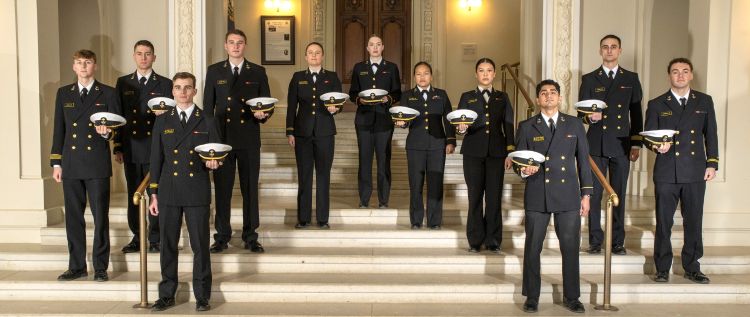

Trident Scholar Abstracts 2026
Olivia R. Achenbach
Midshipman First Class
United States Navy
Analyzing Host Galaxies of Quasars with Young Radio Jets to Determine Jet-Triggering Conditions and the Impact on Galaxy Evolution
Active galactic nuclei (AGN) play a crucial role in galaxy evolution by influencing star formation and gas dynamics through their feedback mechanisms in the form of relativistic jets. Despite their importance, the exact mechanisms that trigger their jets and how jet feedback affects the host galaxy remain poorly understood. There is still much debate about whether external processes, like galaxy mergers, or secular processes, like bar-driven fueling, play a more significant role in triggering jets. To evaluate what environmental conditions trigger jets, we obtained Hubble Space Telescope Wide Field Camera 3 Infrared (WFC3/IR) images of the hosts of four quasars caught launching newborn jets in the past 10-20 years by the Very Large Array Sky Survey. These broad-line (Type 1) quasars from the Sloan Digital Sky Survey (SDSS) have redshifts of 0.2 < z < 1.0 and require the exquisite sensitivity and resolution of the Hubble Space Telescope to reveal their host galaxy morphologies. We investigated the underlying morphologies of the hosts by performing quasar host galaxy decomposition to separate the light of the quasar from the host galaxy. Our morphological results revealed that the two lower redshift galaxies show clear signs of mergers or external interactions, and the two higher redshift galaxies do not show clear signs of extended features and limited resolution. Our photometric analysis quantified the luminosities and masses of each galaxy and found 10742 to be the most massive of our sample. Furthermore, we found evidence of faint radio jets in 10742, indicating radio jets are part of a cyclic process in a galaxy's lifetime. Overall, a significant fraction of our sample shows radio jets triggered by external interactions, and the implications of this piloting study improves our understanding of the role of galaxy mergers in the triggering of quasar jets and galaxy evolution.
FACULTY ADVISORS
Professor Christopher Morgan
Physics
Assistant Professor Dana Anderson
Physics
EXTERNAL COLLABORATOR
Dr. Kristina Nyland
US Naval Observatory
Nicholas T. Ciaccio
Midshipman First Class
United States Navy
One-Way Attacks Against Surface Ships: Learning from World War II and the Russo-Ukrainian War
Under what conditions do one-way attack systems succeed, specifically when targeting surface ships? Existing studies of one-way attack systems suggest that attackers experience greater success in targeting and damaging ships when the systems deploy in larger numbers (Caverley and Petersen 2025). These studies do not tell us whether attackers' use of environmental conditions influences effectiveness or if there is a linear relationship between the number of attackers and success. To explore these issues, I built two datasets from cases of one-way attacks against ships: the use of Japanese kamikaze aircraft in the Battle of Okinawa (1945) and the use of Ukrainian drones in the Black Sea during the Russo-Ukrainian War (2023-2025). I use descriptive statistical analysis, logistic regression modelling, and qualitative evidence to answer my research question.
I found that Japan experienced higher success rates when kamikaze pilots exploited terrain features in the maritime domain such as cloud cover. Japan also saw greater success when employing mass formations of multiple aircraft. This effect was non-linear: as the number of attackers grew, the success rates initially increased, then leveled off at a distinct threshold of 25 aircraft, creating a situation of decreasing marginal utility for Japan.
I found that Ukraine also experienced higher success rates when it conducted mass attacks. However, in contrast to Okinawa, Ukraine's success rate was relatively constant when using 1-10 drones. Only once the size of Ukraine's attacks crossed into a critical range of 11-15 drones did success rates begin to increase.
This study provides evidence relevant to scholarly and policymaker debate regarding the effects of attacker skill, the number of attackers, and military learning on one-way attack systems' effectiveness. Military leaders must continue to prioritize effective drone operator training and be methodical about the number of drones to use in attack swarms.
FACULTY ADVISORS
Assistant Professor Cullen Nutt
Political Science
Assistant Professor Alexis Lerner
Political Science
Margo Z. Cicero
Midshipman First Class
United States Navy
Additive Manufacturing of Photopolymerizable Lithium-6 Doped Organic Plastic Scintillators
Nuclear materials in reactors and weapons emit radiation that can be measured and analyzed. Detecting this radiation enables tracking of nuclear materials, verification of nuclear treaties, prevention of wrongful use, and insight into foreign nuclear activities. Plastic scintillators with triple radiation discrimination capability of gamma rays, fast neutrons, and thermal neutrons are critical for the detection of special nuclear material in non-proliferation applications.
Stereolithography (SLA) 3D printing is a novel manufacturing technique that enables geometric modularity in scintillator design with rapid polymerization times. This study investigates the effects of monomer chemistry and crosslinker composition on the photopolymerization of organic plastic scintillators. Four base monomers, vinyl toluene (VT), styrene, benzyl methacrylate (BMA), and methyl methacrylate (MMA), were tested alongside a mixed crosslinker composed of divinylbenzene (DVB) and pentaerythritol tri-acrylate (PETA).
The results revealed a direct trade-off between polymerization time and radiation detection performance. Scintillators with aromatic components had improved radiation detection capabilities, while scintillators with acrylate components polymerized significantly faster. The undoped optimized scintillator resins performed at 59% relative light output. The addition of Lithium-6 for thermal neutron detection was also investigated for solubility, detection performance, and polymerization kinetics. This doped scintillator had a relative light output of 40%, Figure of Merit of 1.19 for discriminating neutrons and gammas, and thermal neutron detection capability.
This work demonstrates the first successful use of off-the-shelf SLA printing to fabricate scintillators using a combined DVB-PETA crosslinker, introduces a novel formulation for a Lithium-6----doped 3D-printed scintillator, and establishes a pathway for future development of additively manufactured organic plastic radiation detectors capable of triple radiation discrimination.
FACULTY ADVISORS
LCDR Joseph Latta, USN
Mechanical and Nuclear Engineering
Professor Peter Joyce
Mechanical and Nuclear Engineering
Assistant Professor Megan Mohadjer Beromi
Chemistry
William G. Hardaway
Midshipman First Class
United States Navy
Historically, laser power transfer (LPT) has been too inefficient to be applied to commercial systems. However, recent advances in laser and photovoltaic (PV) cell technologies have made power beaming a more viable energy transfer method. The increased power efficiency of LPT systems has also introduced the possibility of using them to double for communication. This research investigated the effects of laser diode amplitude modulation to integrate a communication link into a modern LPT system. The system used three laser diodes operating at wavelengths of 520 run, 852 run, and 1455 nm to match the bandgap energies of an InGaP, GaAs, and Ge triple-junction PV cell. The LPT system demonstrated a maximum transmission of 56.5 mW at an efficiency of 32.9%. Additionally, this research demonstrated that modulation of the 520 nm laser diode at a modulation depth of 5% relative to peak power, in conjunction with a multi-junction PV cell, provided an effective method of communication and power transfer. The communication link used an M-ary Amplitude Shift Keying scheme capable of transmitting 600 bits per second at a 200Hz bandwidth. The architecture achieved an average communication power efficiency of 96.07% and a total power efficiency greater than 31.6%. The results demonstrate the viability of integrating communication capabilities into power beaming technologies. The combination of these two systems could drastically decrease the size, weight, and power (SWaP) of any rover, spacecraft, or electrical system.
Aerospace Engineering
Professor Charles Nelson
Electrical and Computer Engineering
Midshipman First Class
United States Navy
The transmission of optical signals through underwater environments is of paramount importance for naval operations and secure communications. However, this aquatic chan-nel is severely challenged by temperature-driven optical turbulence, causing signal fading and beam wander in traditional communication systems. This research investigated the underwater propagation of vector vortex beams (VVBs) as a topological solution to these deleterious effects. Unlike scalar modes that suffer from turbulence-induced crosstalk, VVBs feature classically entangled spatial and polarization modes. We hypothesized this non-separability—quantified by the degree of polarization (DoP)—acts as a robust topological invariant. We theorized this structure remains stable even when unitary turbulence operators severely distort the beam’s physical intensity, because refractive index fluctuations act as a polarization-insensitive multiplier.
A Rayleigh-Bénard natural-convection tank experimentally validated this theory, simulating underwater turbulence across a 0 to 4◦C temperature gradient. Upon propa-gating the VVBs, the spatial intensity profile underwent severe scintillation. However, quantitative analysis revealed a critical distinction between physical intensity degra-dation and informational stability. While the subaqueous thermal channel introduces significant noise, the signal remains tightly bounded and oscillates around its intended mean, preserving the fundamental optical state. For example, focusing on the ND0.5 attenuation level, the T0 baseline maintains a highly stable degree of polarization char-acterized by a standard deviation of 0.0278, and under the TM regime, the standard deviation increased to 0.0876. The zero-mean variance exhibited dramatic, quantifiable growth. For the highly attenuated ND0.8 state, the variance surged from 3.06 × 10⁻⁴ in the undisturbed T0 channel to 62.37 × 10⁻⁴ under moderate TM turbulence. The ND0.5 state experienced a variance increase from 7.73 × 10⁻⁴ at T0 to 76.68 × 10⁻⁴ at TM.
Despite this growth in variance, the underlying mean drift remained tightly bounded near zero across all combinations, with a maximum total shift of 0.0398 over the observation window. This lack of systemic drift is a vital indicator: it proves that even though the turbulence introduces severe noise and broadens the variance of the measurements, the core degree of polarization is still successfully transmitted through the channel and accurately read at the receiver. The encoded vector state definitively survives the thermal distortions. Consequently, future iterations of this optical system, featuring higher levels of precision alignment, faster detection frame rates, and enhanced intrinsic beam stability, could significantly minimize this observed variance, further tightening the signal boundaries for advanced communication protocols.
These findings validate the hypothesis that VVBs avoid topological decoherence. By successfully modulating the DoP into distinct levels, we established a viable commu-nication alphabet based on polarization topology, offering a highly resilient pathway for data encoding where traditional intensity-based schemes fail. We established an absolute confidence of detection metric to evaluate this alphabet. When enforcing a strict ±0.050 detection threshold, the ND0.5 signal’s detection confidence fell to 35.7% under moderate TM turbulence. However, expanding the detection tolerance to ±0.150 successfully rescued the heavily degraded ND0.5 TM signal to an 88.0% confidence level. This expanded tolerance requires a minimum channel separation of 0.300 to prevent crosstalk, concluding that a highly viable 3-to-4 channel multiplexed communication system can be successfully deployed in moderate underwater turbulence.
FACULTY ADVISORS
Professor Svetlana Avramov-Zamurovic
Weapons, Robotics, and Control Engineering
Professor Charles Nelson
Electrical and Computer Engineering
Professor Robert Niewoehner
Aerospace Engineering
EXTERNAL COLLABORATORS
Dr. Nathaniel Ferlic
Naval Air Warfare Center
Professor Andrew Forbes
University of the Witwatersrand (South Africa)
Ryan J. McKee
Midshipman First Class
United States Navy
Feature Engineering for Generalizing Near-Maritime Atmospheric Optical Turbulence Machine Learning Models
As the United States Navy integrates high-energy laser (HEL) weapon systems and free-space optics (FSO) communications into maritime operations, accurate prediction of atmospheric optical turbulence (Cn2) is critical for maintaining operational effectiveness. Traditional physics-based models often struggle in the complex, non-homogeneous low-altitude maritime boundary layer, while purely data-driven machine learning (ML) models frequently suffer from regional over-specificity, leading to catastrophic performance degradation when applied outside their training environments. This research introduces a hybrid approach designed to enhance ML generalizability across varying geographical regions through physics-informed feature engineering. By transitioning from absolute meteorological variables to dimensionless physical ratios and gradients, such as the Bowen ratio proxy, vapor pressure gradients, and wind stress, we attempt to capture the universal physical drivers of refractive index fluctuations.
Random forest regression models were trained and cross-tested using high-fidelity datasets from Annapolis, MD, and San Diego, CA. The efficacy of the engineered features was evaluated using relative feature importance, which confirmed a shift in model reliance from site-specific absolute values to universal thermal and moisture gradients. Furthermore, residual error analysis was employed to better visualize model performance, revealing distinct error cloud shapes and model deficiencies. Quantitative results indicate that the physics-informed models achieved a 42.3% to 65.6% reduction in Mean Squared Error (MSE) (over the original models) when cross-tested in foreign regions, demonstrating increased model generalizability. This methodology provides a robust framework for deploying generalizable turbulence predictors across diverse littoral theaters, ensuring the reliability of naval directed energy and communication systems in unpredictable maritime environments.
FACULTY ADVISORS
Professor Charles Nelson
Electrical and Computer Engineering
Professor John Burkhardt
Mechanical and Nuclear Engineering
Professor Cody Brownell
Mechanical and Nuclear Engineering
Midshipman First Class
United States Navy
Physical Adversity and the Development of Human Capital
This paper investigates the causal impact of experiencing and overcoming physical adversity on short-term academic performance. Using a longitudinal dataset from the United States Naval Academy (USNA), we exploit exogenous variation in the high-stakes Physical Readiness Test (PRT) driven by ambient weather conditions and peer-group performance to answer the question, "What are the consequences of failure?" The pre-2020 PRT consists of push-ups, curl-ups, and a 1.5-mile run, which a midshipman must pass each semester to maintain enrollment. Failure of the PRT results in subsequent mandatory physical remediation through the Brigade Training Team (BTT) until they pass a make-up PRT. We demonstrate that Ordinary Least Squares (OLS) and Regression Discontinuity Design (RDD) exhibit endogeneity in this setting. We overcome this by utilizing a series of RDD such as a "donut" RDD where we remove midshipmen observations just above and below the PRT failure cutoff to address the issue of clumping. We validate these results by employing a two-stage least squares (2SLS) framework with individual, career, and academic year fixed effects to isolate the impact of PRT failure on midshipmen outcomes. Our preliminary results identify a significant "crowding out" effect, where the time-intensive nature of remediation leads to a short-term decline in the Academic Quality Point Rating (AQPR) with no evidence of future benefit. While the weather instrument provides a clean exogenous shock, it is relatively weaker compared to the peer-group instrument. However, we discuss potential biases in the peer-group instrument stemming from peer and leadership effects. Our findings contribute to preexisting literature surrounding the trade-offs between physical fitness and academic performance. We hope to further build on this research by analyzing labor market outcomes.
FACULTY ADVISORS
Professor Katherine Smith
Economics
Professor Michael Insler
Economics
Associate Professor James Harrison
Economics
Aayush Sharma
Midshipman First Class
United States Navy
Reading Between the Lines: A Machine Learning Approach
Every quarter, company executives of public companies brief the public on the state of their companies in earnings calls. Financial analysts have long believed in the importance of what is said in these meetings since they talk about future plans and explain past and present finances. However, executives do not always convey accurate information about their companies because they do not have a crystal ball to see their future development, and they may hold biases to mask information. We propose new methods that attempt to computationally model the speech patterns of these earnings calls to predict company performance. We investigate these earnings calls using four hypotheses as a framework: (1) earnings calls use consistent language that can be modeled by neural networks to predict performance (2) trained classifiers more accurately predict earnings call outcomes in the future than the present, (3) language used in earnings calls is more predictive in good economic times versus bad economic times, and (4) language used in defensive company earnings calls are more predictive than that of cyclical companies.
The contributions of this project are that we have successfully trained a model with a 10% increase in absolute accuracy over the baseline and 25% relative increase in accuracy over the baseline. In doing so, we also created a search algorithm that can extract specific information from complex 10-Q form. We also proved that it is possible to use an encoder-based approach to identify sentences of interest for language modeling. Throughout our research, we did not find language differences between different sectors and economic activity.
FACULTY ADVISOR
Professor Nate Chambers
Computer Science
Rory M. Smith
Midshipman First Class
United States Navy
Using Machine Learning to Identify the Sensitive Parameters of an FDA-Approved Dynamic Type 2 Diabetes Model
Diabetes mellitus, commonly referred to as diabetes, is a physiological disorder that affects millions of Americans, especially U.S. service members and their families. It causes unregulated blood glucose levels that increase the risk of heart attack, stroke, and kidney failure. Predictive dynamic models have been developed to represent the body's complex feedback system that regulates insulin and glucose. The Dalla Man-Cobelli meal simulation model of the glucose-insulin system is one such dynamic model that has been approved by the U.S. Food and Drug Administration as a substitute to animal testing. The model provides a physiologically accurate depiction of glucose and insulin flow using a number of related differential equations, which are governed by 35 physiologically significant parameters. This dynamic model can predict blood glucose levels for diabetic patients, and they can inform patients when to use treatment measures.
This project investigated the physiological mechanisms within the glucose-insulin system that have the greatest impact on diabetic behavior, to include blood glucose concentration. The proposed sensitivity analysis contributes to ongoing research toward diabetic treatment options by generating synthetic data for a large number of virtual diabetic patients using digital twins based on the FDA-approved, physiologically-accurate Dalla Man-Cobelli dynamic diabetes model. Linear and nonlinear statistical models were trained and tested on this data to identify the most effective parameters within this dynamic model with respect to steady-state and maximum glucose and insulin concentrations. The analysis identifies a concise set of high-impact parameters that closely correspond to the known therapeutic targets of current GLP-1 receptor agonist technologies, providing independent computational validation of existing treatment strategies. These parameters present the basis for future research into real-world treatment options that optimize blood glucose concentration to remain within a safe range.
FACULTY ADVISORS
Professor Richard O'Brien
Weapons, Robotics, and Control Engineering
Associate Professor Paola Jaramillo Cienfuegos
Weapons, Robotics, and Control Engineering
EXTERNAL COLLABORATOR
Dr. Eileen Tatum
Naval Medical Center - San Diego
Mollie A. Stracensky
Midshipman First Class
United States Navy
System Identification and Model Validation of a Blown-Wing Tailsitter Unmanned Aerial Vehicle (UAV)
Unmanned aerial vehicles (UAVs) with vertical takeoff and landing capabilities are a rapidly growing aspect of the aerospace industry due to their efficiency, low cost, and commercial and military applications. Flight test data play a crucial role in the development of these aircraft, asthey inform various aspects of the design process and allow for continuous capability enhancements. One particularly valuable use of flight testing is system identification, which enables the creationof accurate dynamic models that describe aircraft behavior and performance based on the responseto control inputs. These models can then be used directly for control design and piloted simulation, or to validate physics-based models. This project was a practical application of system identification for a novel blown-wing tailsitter UAV configuration. The blown-wing tailsitter is a valuable design that maximizes hover performance with forward flight capabilities.
Flight testing of the UAV in both hover and forward flight was performed at the Naval Academy, both indoors in the Aerial Robotics Testing and Mission (ARTeMis) laboratory and outdoors at Hospital Point. A non-parametric identification was developed directly from flight test data using the frequency response method. This method analyzed the response to sinusoidal input signals over a range of frequencies to generate a frequency-response matrix, which helped describe the correlation between different inputs and their effects on the aircraft dynamics. A parametric state-space identification was then performed, wherein the frequency-response data were fit to a differential equation model of aircraft motion. The combination of the non-parametric and state-space identifications resulted in a mathematical model that closely mirrored the aircraft's dynamic behavior observed in actual flight.
The results from this project provided the stability and control derivatives, as well as a comparison metric for the trim and linear responses of simulation models. The data provide insight into the merit of this UAV design, contribute to the growing database of dynamic response information, and help improve the accuracy of relevant simulation models in the aerospace industry.
FACULTY ADVISOR
Associate Professor Ondrej Juhasz
Aerospace Engineering
EXTERNAL COLLABORATOR
Dr. Jean-Paul Reddinger
Army Research Laboratory
Daisy Zamora
Midshipman First Class
United States Navy
Zooming In on Dual and Binary Supermassive Black Holes with the James Webb Space Telescope (JWST) using Aperture Masking Interferometry (AMI)
We present an analysis of synthetic observations of dual and binary Supermassive Black Holes (SMBHs) using the technique of Aperture Masking Interferometry (AMI) in order to create a proposal for time on the James Webb Space Telescope (JWST). AMI using JWST’s Near Infrared Imager and Slitless Spectrograph (NIRISS) instrument provides an unprecedented angular resolution of 65 mas at high sensitivity, enabling direct imaging of binary and dual SMBH systems.
We accomplish our objectives by building an initial model chosen from the “Big MAC Catalog,” the largest catalog of active galactic nuclei. We then predict the interference pattern of our chosen system using AMI and use this data to simulate what JWST will observe. This step produces preliminary models, which we validate through an extensive literature review that determines the relevant parameter space for our observations. If the parameters do not support our data, we return to our models and make the necessary adjustments. Upon completion of our models, we select three targets for future JWST observations based on the results of our simulations. This project represents a crucial step in a long-term investigation.
FACULTY ADVISOR
Professor Jeffrey Larsen
Physics
EXTERNAL COLLABORATORS
Dr. Kristina Nyland
US Naval Observatory
Dr. Jordan Stone
Naval Research Laboratory
