
Capstone Multidisciplinary Courses
Individual Department Capstone Courses
Aerospace Engineering
EA440 Aerospace Vehicle Design • EA469 Special Space Craft Design • EA470 Spacecraft Design
Electrical and Computer Engineering
EE411 Electrical and Computer Design I • EE414/EC415 Electrical and Computer Design II
Mechanical Engineering
EM471 Mechanical Engineering Design I • EM472 Mechanical Engineering Design II
Naval Architecture & Ocean Engineering
EN471 Ship Design I • EN476 Ship Design II • EN461 Ocean Systems Engineering Design I • EN462 Ocean Systems Engineering Design II
Weapons, Robotics and Control Engineering
ES401 Engineering Design Methods, • ES402 Systems Engineering Design • ES403/404 Engineering Design Methods
General Engineering
EG471 Engineering Design I • EG472 Engineering Design II
Multidisciplinary Courses
EX485M Interdisciplinary Capstone Design • EX486M Interdisciplinary Capstone Design
Overview • Format • Timeline • Project Selection • More Info
Overview
The capstone project, as the name suggests, is the culminating event in a student’s undergraduate educational experience. Students are asked to define the scope of an open-ended problem, use the tools they’ve learned in previous courses to analyze the problem and evaluate alternatives, learn to manage a long-term project, and work as a team with their fellow students. Inclusion of a capstone experience is mandated by the Accreditation Board for Engineering and Technology (ABET) and is undertaken by all accredited engineering departments in the United States.
Each engineering department at the US Naval Academy offers a capstone design course. The Multidisciplinary Capstone Design Courses are offered at the division level and can be taken by students of any engineering major who are interested in working on a multidisciplinary project.
Why offer a separate multidisciplinary course?- Many design processes are non-discipline specific
- It more accurately reflects the reality of design work conducted in industry
- It provides the opportunity to work on a wider variety of real-world projects
- It allows us to bring a much broader scope of resources to bear on a single problem
- It teaches students to appreciate and value the similarities and differences between themselves and students from other majors
Course Format
Each faculty instructor is assigned three to four teams and will stay with those students through fall and spring semester. Their role is to mentor the team through the design process and help the team to manage their time, manpower, and resources. Additionally, technical advisors are assigned, one faculty member per team, to assist the instructor and the team in completing the project. Technical advisors are paired with teams based on their knowledge of or experience with the associated subject matter.
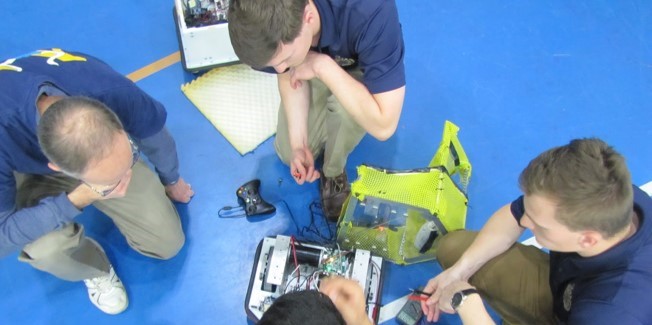
During the fall semester, teams are provided instruction in project management and the engineering design process. They work to define the problem, gather information about their customers, conduct a trade study to determine the state of the art, develop potential solutions, use analysis tools to predict the performance of those solutions, select from among them, and plan the prototyping process. During the spring semester, students fabricate designs, test them on the basis of their customer requirements, and redesign as time permits. The final presentation for the course is given on Capstone Day, typically the last week in April.
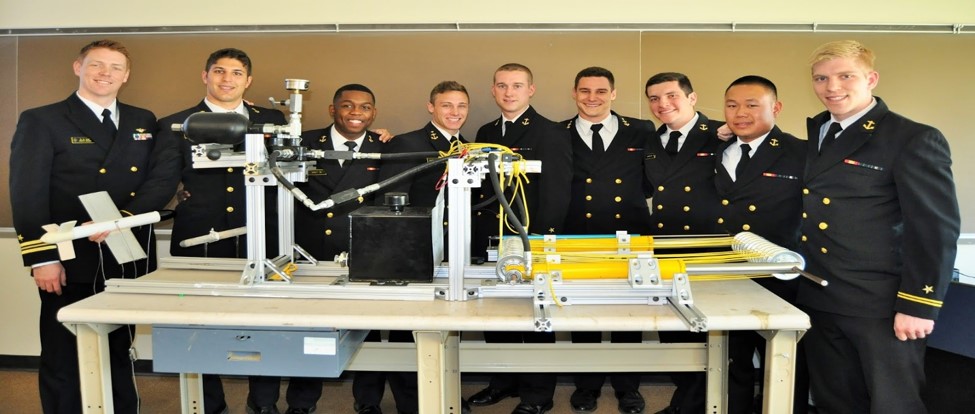
Team Eagle Claw, the Boeing UAV capture team, includes student engineers in electrical, general, mechanical, and weapons and systems engineering
Timeline
Engineering Design I (EX485M) and II (EX486M) is a two-course sequence, typically taken during a midshipman's first-class (senior) year. However, project selection begins in the spring of a student’s second-class year, as shown in the table below.
| Spring Semester | February | Initial project proposals |
|---|---|---|
| March | Project selection and assignment | |
| April | Site visit and initial meetings | |
| Summer Semester | June - August | Internship |
| Fall Semester | September | Problem definition |
| November | Concept generation and selection | |
| December | Embodiment design | |
| Spring Semester | January | Prototype demonstration |
| March | Testing, evaluation, and redesign | |
| April | Capstone Day and final report submission |
Project Selection
Click for details and deadlines to propose a future project.
Early in spring semester the Capstone Committee collects projects from current customers and potential future partners. The result of the collection process is a list of potential multidisciplinary projects and associated summaries. These summaries are made available to students with sufficient time to learn more about the project prior to selection. In the meantime, the students form groups of approximately four and decide collectively which projects most interest them. In mid-March, a project selection fair is held during which each group has a chance to bid for projects. By the end of the fair, most teams walk away with a project and instructor assigned. The benefit of selecting in March is that at least a month remains of the semester. This gives new teams the opportunity to visit their customers prior to departure for summer break. For teams working on a multi-year project, one team is able to turn the project over to the next.
Students from all majors within the division are invited to participate in the multidisciplinary courses. Each department has approved the course to fulfill the capstone design requirement for each major. Students from the Electrical and Computer Engineering and Mechanical Engineering Departments are signed up for the multidisciplinary course by default, however interested students can be approved to take other departments’ courses on a case-by-case basis.
Links for more information
Advice From PredecessorsProjects
FAQ / How to...
